
We’ve been championing senior bosses for many years – and now there are one million of them. So is our work done?

The news that there are now over 1 million part-time employees at senior or management level is definitely worth celebrating. It’s not just a big number, it’s an indication of a real shift in attitudes and culture. Especially compared to the bad old days, when this kind of flexing only really went on under the radar.
It was the secrecy attached to part-time leadership that led to the launch of the Timewise Power 50 in 2012. We knew people were doing it, but they were doing so very quietly, so we set out to create some noise. And now, eight years on, many senior part-timers are loud and proud.
So is our work done? Should we raise a glass to what we’ve achieved, and move on? You won’t be surprised to hear that my answer is no.
While it’s great that so many senior part-time requests have been accommodated, what happens when the individuals involved want to find their next promotion? The data suggests they are likely to struggle; as we revealed in this year’s Flexible Jobs Index, only 15% of jobs are currently advertised as having any flexibility at all.
What this means is that these senior flexers are in danger of having no flexible next step, or having to trade their hard-won flexibility away to keep climbing. It’s almost like a game of musical chairs; sure, you can grab your bit of flex, but you won’t necessarily get to keep it if you go for a promotion.
If we’re going to keep moving forwards, we can’t just settle for helping people find a way to make their current job flexible. We also want them to be able to take their arrangement to the next one, and the one after that, and the one after that. And that means we need to make flexible recruitment into the next big thing.
How? Well, experience has shown us that what gets measured gets changed. For example, a focus on the gender split at board level has resulted in women holding one third of board roles at FTSE 100 companies. And following the legislation requiring companies to track their gender pay gap, things are starting to move in this area too.
It’s reasonable to assume, then, that a similar requirement for companies to track flexible hires and promotions would help speed up the pace of change. And while this would need to be tackled at governmental level, we all have a part to play.
So if you’re hiring flexibly already, that’s brilliant. Keep doing it, and do it more. Shout about it on your website and highlight it when you’re briefing recruitment agencies. Be upfront on your ads that you’re happy to discuss flexible options (having first made sure the roles you’re offering can work on that basis).
If you’re not, it’s definitely time to get started – and we can help. Do get in touch with the team, so we can support you as you take your next step.
Published February 2020
By Emma Stewart, Co-Founder Timewise

Does flexible working improve productivity? That’s the question I was invited to consider by wellbeing specialists Carnegie Trust UK, for their collection of essays, Can Good Work Solve the Productivity Puzzle?
The short answer is yes, from what we know, but we need to know more. I’ll explain why below; if you’re interested in the longer answer, it’s chapter 15 in the collection.
So what do we know? Well, there is some (limited) data on the link between flex and productivity. A 2014 survey by BT found that the productivity of flexible workers increased by 30%. Similarly, a YouGov survey from 2015 suggested that 30% of office workers felt their productivity increased when they worked remotely. And in a study of flexible workers undertaken by Cranfield University[1], over 90% of managers said the quantity and quality of work improved or stayed the same.
Additionally, there is an argument for flexible working having an indirect impact on productivity, due to its direct effect on other workplaces issues. Flexible working has been shown to boost talent attraction, retention and progression, and drive inclusion and diversity. It also delivers better work life balance, with the knock on effect of supporting mental and physical health and wellbeing.
It’s therefore not a huge leap to assume that if you’re working fewer days a week, or in a job that fits with your life, you are likely to be more engaged. Or that working from home, with fewer interruptions, can increase your output. Or that hanging on to experienced, knowledgeable staff will help the whole team succeed.
Certainly, these assumptions have contributed to increased interest, and trials of, the four-day working week. A key early example of this, Perpetual Guardian in New Zealand, ran a pilot which they say revealed a 20% increase in productivity. And a number of companies in the UK have followed suit.
However, as I’ve explained in detail elsewhere, introducing a four-day working week isn’t just a schedule tweak. In frontline and shift-based sectors, such as teaching, retail or manufacturing, it is hugely complicated to introduce – or only possible to do so at a prohibitively high cost to the business.
So if the four-day working week isn’t the answer, what is? I believe there are two big steps we need to take if we’re to use flexible working to solve the productivity puzzle:
At Timewise, we’re already on this journey. We’ve led a number of research projects exploring innovative flexible options, in complex sectors such as nursing, teaching and retail. Right now, we’re piloting flexible working in the construction industry, and investigating the role that flexibility can play in supporting returners and older workers.
But to really embed this work, we need more social partnerships between business sector bodies and agents for change, backed by government and industry investments. That’s the way to take productivity to the next level, whilst delivering a happier, healthier workforce.
Published January 2020
[1] Cranfield University/Working Families 2008: “Flexible Working and Performance”

Getting and keeping staff is now the number one challenge for the NHS. And the NHS Long Term Plan recognises that poor work-life balance is a key underlying reason.
From our work across many sectors, Timewise knows that work-life balance is a key element of any ‘great place to work’. But how can hard-pressed ward managers, trying to provide 24-hour patient care with limited resources and at the same time satisfy clinical requirements for particular skills on particular shifts, also facilitate work-life balance for nurses?

Timewise set up a pilot to explore one way of addressing this problem. We worked with 240 nurses in seven wards in three hospitals, to test whether a team-based rostering system could improve nurses’ work-life balance. The aim was to increase nurses’ input into their own working patterns.

It’s the Timewise view that no profession is un-flex-able. Yes, it’s much more complex in shift-based environments, or those offering a 24 hour service. That’s why we created our Innovation Unit, through which we tackle these hard-to-fix sectors. But impossible? No.
Yet when it comes to teaching, there is a commonly held view that it is just too complicated, particularly because of timetabling. There’s also a concern around the potential cost; Laura McInerney’s much-read 2018 piece suggested that making more part-time teaching jobs available is unaffordable, because of the extra teachers it would require. And, as in many professions, there is inevitably some resistance from leaders and colleagues.
Certainly, there are constraints within teaching that make introducing part-time and flexible roles less straightforward. But my response to the comment that we can’t afford to offer more part-time and flexible teaching roles is this: we can’t afford not to. Our new report, published in association with Now Teach , explains why, and offers some first steps to help secondary schools create viable solutions.
Flexible working can help schools find and keep brilliant teachers
It’s no secret that the profession is struggling to find and keep its teachers. The government has admitted that it has missed its targets for teacher recruitment for six years running. And when people do join the profession, they often don’t stick around long; government figures have also indicated that a third of NQTs leave the profession within five years. Increases to teacher workloads certainly haven’t helped.
Of course, there are limits to what schools can offer current and potential teachers. They will never be able to match corporate salaries, for example. But one thing they can do is try and give their staff more control over their time and work-life balance.

There’s no doubt that flexible working is becoming an established part of the HR strategy for forward-looking companies. Employers are becoming increasingly vocal about how it benefits their business, and 9 in 10 employees say they want it. What’s more, it has been shown to help tackle a wide range of issues, from talent attraction and retention to the gender pay gap.
But the term ‘flexible working’ is a broad one, which means different things to different people. To add to the confusion, some people and companies use different phrases to describe it, such as ‘agile working’ or ‘smart working’. So here’s our quick guide to what flexible working actually is, how to make it work, and what it could do for you.
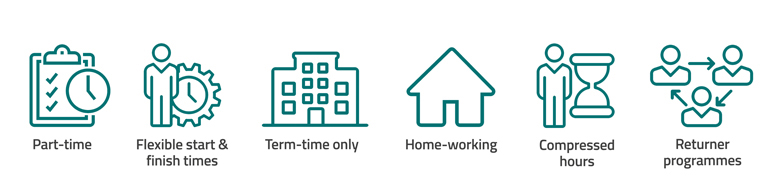
At Timewise, we use the term ‘flexible working’ to describe any kind of working pattern that doesn’t fit into the traditional 9-5, five day week. We also believe that flexible roles should be quality, permanent ones which benefit employers and employees alike. So we don’t include zero hours or temping contracts.

Karen Mattison MBE, Co-Founder Timewise
It feels as if the Timewise Power 50 has finally come of age. Launched seven years ago to bring senior part-timers out of the shadows, it has evolved over time to become a high profile celebration of the art of the possible.
What’s changed, and how has it happened? Well, in the intervening years, the debate about flexible working has undergone a big shift. Critically, there’s an increasing acceptance that it benefits companies as much as it does their employees; the business case is no longer in doubt. So instead of talking about WHY we need it, the conversation has moved on to HOW to make it work.
The most varied group of winners to date
As this year’s winners show, there are many different ways to do so. They are the most varied group that we have ever seen, coming from a wide range of organisations of all shapes and sizes. Where else would you see a security chief sharing the limelight with a pair of West-End performers? Or a consultant anaesthetist being celebrated alongside the head of a music label?
And their motivations are equally varied. Some of our winners work flexibly to care for relatives; others do so to write books and musicals. Or to pursue a side-hustle, to dedicate time to not-for-profit projects, or to look after their mental and physical health. The career choices they’ve made are supporting them to live and work in the way they want to, and helping to bust some myths around flexible working on the way.

Over the years, as we’ve been working to bring about more, better flexible working, we have created a core set of principles on which successful flexible job design should be based. As a top line – though of course, it’s a far more in-depth process – this involves looking at where, when and how much people want or need to work, and using this as a base to create roles which suit both employers and employees.
But when it comes to shift-based environments, such as retail, healthcare, warehousing or hospitality, these variables can’t be applied in the same way. The where is often a fixed location – a hospital, for example, or a restaurant. The how much is often problematic because of the low wages associated with many of these roles; for some, a part-time minimum wage isn’t enough to get by. And the when can be too driven by the employer’s requirements – such as needing a full, balanced team to cover each shift – to take employee needs into account.
Does that mean it’s impossible to deliver a good work-life balance for shift-based employees? No. But it does mean we need a different set of principles, and a different way of talking about flexible working, from which to build the change process. So here it is.
Drawing on the work of USA-based academic Sue Lambert, as well as our work in tough-to-crack sectors, we have identified the principles which improve work-life balance for shift workers in the UK. And we’ve used them as a basis for a Shift-Life Balance model for the home market.
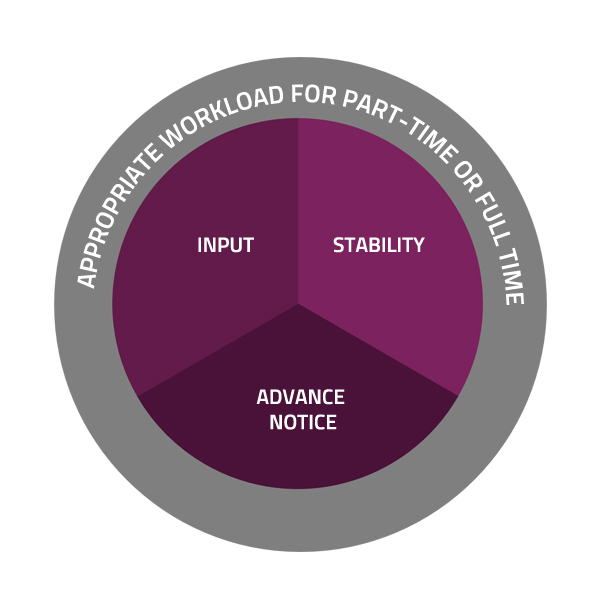
Shift-Life Balance: a model for change
The first, overarching principle is about the size and volume of work: does the individual want to work full-time or part-time? Once this has been defined, employers then need to consider:
The aim of these principles is to help employees manage their responsibilities outside of work, make plans and organise the rest of their lives.
Of course, as with all types of flexible job design, identifying the principles that make up this Shift-Life Balance model is just the beginning. The extent to which an employer is willing or able to tackle one or more of them will vary case by case.
And it’s not just a case of making a few tweaks. These principles are fundamental to the way that rosters and shift patterns are created. So any changes need to be tried and tested to ensure that they deliver. That’s where we come in.
We are already using this model in a range of pilots which we’re carrying out through our Innovation Unit, from nursing and retail to teaching, and we’ll share the outcomes as they develop. If you’d be interested in hearing more about what we’re doing, or supporting one of our projects, do please get in touch.
In shift-based environments, the structures and cultures we need to tackle are deeply-embedded, and in some cases, resistant to change. That’s why this work hasn’t been done already – and why it needs the level of expertise that our Innovation Unit can bring.
But if we don’t tackle these challenging sectors, and flexible working remains a white-collar, office-based privilege, what will the impact be? Put simply, we’ll be failing the millions of employees, often in lower paid jobs, who are struggling to balance their work and home lives. And these jobs matter – not just to the people who work in them, but to all of us.
For example, there are an estimated 40,000 nursing vacancies in the UK; the lack of flexible working options has been identified as one of the reasons. Similarly, the construction industry needs 157,000 new recruits by 2021 to keep up with demand. And more than 47,000 new secondary school teachers are needed over the next six years. In total, 5.5 million workers in the UK work shifts – that’s a sixth of the working population.
Workers in these sectors need predictability and control over when they work – just as much as those in office-based jobs. And employers need to find a way to make this happen if they are to motivate and engage their existing employees and, crucially, attract new ones. We believe we can crack these challenging sectors, and that’s why we’re rolling up our sleeves and getting on with this complex work. It’s a prize worth aiming for, for all of us.
Published February 2019

In the 12 years that Timewise has been focusing on the flexible jobs market, we have heard anecdotal evidence of a key barrier facing part-time employees: a sense of not being fully part of the team.
This research survey set out to quantify the problem. It found that many part-time workers do indeed say they miss out on key meetings, on professional development events and training, and on networking opportunities.
Among the part-time workers who responded to our survey:
If part-time workers are missing out in these ways, they are unlikely to progress as well as their full-time colleagues. Not only is this a waste of their potential, it could also have a negative impact on their organisation’s gender pay gap. By failing to take part-time workers’ schedules into account when planning important meetings and events, employers are making it harder for these employees to deliver their role to the highest standards, and creating operational inefficiencies.
Employers who really want to benefit from the skills and talents of their part-time workers, need to start thinking differently about the best way to support them.
In simple terms, employers need to think differently. They need to challenge the assumption that, just because something has always been done in a certain way – such as entertaining clients after work, or having team meetings on the same day and time each week – that’s the only way to do it.
By thinking creatively and innovatively about how things are done, employers can deliver a workplace culture and working week that is as inclusive of part-time workers as their full-time colleagues – and benefit from the results.
Specific suggestions, made by the part-time workers in our survey include:
Published September 2018

The staffing crisis in the NHS has the organisation close to breaking point. Large numbers of staff are leaving, with many citing work-life balance as their main reason. And recruitment is challenging, with huge numbers of unfilled vacancies. As a result, agency costs for locums and temporary staff are spiralling.
Flexibility could help to tackle these issues, yet there is no clear definition of what flexible working means within the NHS. The organisation currently tends to operate on a request-response model, in which flexibility is seen as a problem to be accommodated rather than a way to meet the non-work needs of their staff. The variety of roles and ways of working in the NHS adds further complexity, with different solutions needed for shift-based working.
In the last year, Timewise has begun working with a range of NHS Trusts to scope how flexible working can enhance their ability to retain staff. We are also conducting an action research project to help NHS Trusts retain nurses within a 24/7 workplace.
Timewise recommends that the NHS implements a three-part Action Plan for Flexibility, to drive sustainable change
1. Define what flexibility means
The NHS needs to develop a clear definition and vision for flexible working
2. Design flexible job roles
The next step is to create flexible job design options for each profession, job role and specialty.
3. Develop a flexible culture
Organisational cultures which drive and promote flexible working at team level will be essential for the changes to be successful.
In this report, we recommend a fresh approach to redesigning NHS jobs and working practices, taking into account the specific clinical and operational constraints in each profession, job role and specialty. This innovative approach to flexible job design will create role-specific flexible options, for staff at all levels, and will help the NHS to:
Flexible working, done well, could help the NHS to deliver a 24/7 environment which works for all their staff, whatever their other responsibilities. The result would be a dramatic increase in the organisation’s ability to attract, nurture, develop and keep its hard working, talented people.
Published July 2018
Flexibility in working hours is one of the most important reasons cited for choosing to work in retail1. And yet employees who need flexibility all too often become trapped in shop-floor roles by the lack of opportunities to work part-time or flexibly at store management level.
Following an initial pilot with Pets at Home, Timewise launched our Retail Pioneer Programme in 2017, developed with the BRC and five pioneer partners: B&Q, Cook, Dixons Carphone, Tesco and the John Lewis Partnership.
We set out to understand what was getting in the way of offering flexible working at store management level. Through in-depth research with each of the five retailers, we interrogated and challenged the cultural and operational barriers to flexibility. We then identified key changes needed to break down the barriers, so that employees who need flexibility can progress their careers and employers can make the best use of their talent.
Current take-up of flexible working at the five Retail Pioneers’ stores
How retail staff feel about current practice
Under-utilisation of skills
Talented people who need flexibility are being underdeveloped because of the lack of flexible career progression. This might encourage them to leave the industry, and deter others from joining it.
Diversity issues and the gender pay gap
For some of the five retailers, attracting female talent to their stores was a particular challenge. Other retailers had a diverse gender mix at shop floor level, but this reduced dramatically at supervisor or manager roles. As flexible working is disproportionately attractive to women, there is a real opportunity for flexible career pathways to have a positive impact on the gender pay gap for retailers.
Our research points to the need for a 2 step change process:
1 Redesign existing part-time managerial jobs to make them achievable and attractive, supporting management teams to explore how they can redesign workloads and schedules collaboratively.
2 Open up all roles to flex, promoting and hiring people flexibly into managerial roles.
Based on the insights revealed by our research, we worked closely with each of the five retailers to develop tailored action plans containing our recommended job design options. We have been delighted with the responses from the Pioneers, who are taking a variety of approaches, depending on their particular findings and their business priorities.
1 Retail 2020, What Our People Think, May 2016, BRC
Published May 2018