After a seven-year career break, Dr Luke Hepworth returned to Cambridge as a Research Fellow, showing part-time academia is possible and sustainable.
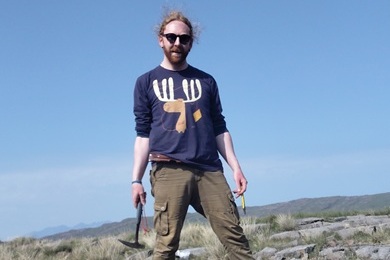
Luke, aged 35, is a Research Fellow at the University of Cambridge in the Department of Earth Sciences.
Although Luke’s work is based in Cambridge, he lives over 260 miles away near Carlisle and mainly works remotely. He works a 2.5 days/week pattern, or 50% hours.
Luke works on something called – and this is the technical term – ‘crystal mush’. Crystal mush is a partially molten mixture of solid crystals and liquid magma that forms when magma gets stuck in the Earth’s crust and slowly cools down and solidifies. It contains high amounts of minerals that are of interest to both tech and industry.
Luke says: “Some parts of my work tell you more about volcanic eruption – it all helps us understand our planet better. Our critical and precious metals also come from these crystal mush bodies. If we understand how they are created, then we’ll be able to find better sources of them. We’re talking about vitally important metals for our economy. For instance, chromium and vanadium for steel making and metal plating.”
When Luke was just 16, he was involved in a serious car accident that left his mother with disabilities. He says: “I had to repeat a year at college, which is when I picked up geology, largely at random. Something about it clicked and I went on to university and I got a first. I also won all the awards in the department. I then went straight onto a PhD, which I produced 4 papers from, including a Nature Geoscience paper, and then took a job that started the day after I submitted my thesis in another part of the country. I recall submitting my thesis and then starting immediately to look at flats in a new city. I was however, completely burned out.”
Luke realised he had to take a break, to support his mental health. He headed home to Carlisle for what was meant to be 12-18 months to take time out before applying for jobs again. However, Covid then hit.
“Mum and I lived in a tight Covid bubble, as she was vulnerable. My career break was suddenly extended by four years – what I assumed would be ‘the end’ in terms of my career in academia. It made me feel extremely anxious. Then suddenly, in 2022 my mum got cancer and sadly passed away. Everything happened so quickly – from the point of her diagnosis to her death was just three months. It was traumatic. After that I experienced a severe depressive and anxious episode.”
He continues: “I sought help and learnt new techniques and coping mechanisms. In October 2023 I contacted the Daphne Jackson Trust, whom I had heard of in a talk at my very first conference in 2014. The Daphne Jackson Trust helps people to return to academia after a break, on a part-time basis to fit with something else in their life. By this point I’d been away from academia for seven years. I felt I had zero to no chance. I was initially hesitant because it was part-time. And actually, as it turns out – I really like the part-time working pattern. It gives you a certain freedom. Massively overstretching myself and burning out was the only alternative – this felt healthier and more sustainable.”
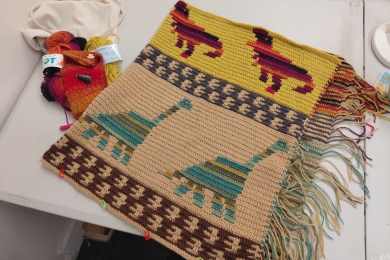
“I do really positive things with my time. I get outside, I get to enjoy cooking. I write creatively. I can get to see my family in London. I even attend a ‘Knit and Natter’ club on a Thursday which I just love. I still feel an immense amount of pressure upon me. But the working pattern kind of supports that.”
“I feel I am an outlier – the only person I have ever met in geology, male or female, who works part-time. It is something people in my field find quite confusing. Which makes it even more important for me, to make sure others know this opportunity and alternative way to work and succeed, exists.
“This is why I talk about my working pattern: I want to be a different voice. I have become an ‘early career researcher’ representative for a special interest group of the Geological Society of London, and in doing so have set up a roundtable precisely for people in my field to talk about problems and sharing experiences that don’t tend to get aired. Usually in academia you only hear ‘blood, sweat and tears’ stories.
“But most people my age actually want to hear from people who have continued to work, or had a break and come back, whilst actively going through big personal things in their lives. Having kids, having mental health breaks, just needing some time for something else in their weeks. With longer working lives, we need realistic role models. I also had an autism diagnosis a year ago and have realised that this way of working really suits me and would suit a lot of people if they had the opportunity.”
“Working part-time has made me form protective, positive boundaries that enable me to work to my best. It has been a stepping stone back to my academic path, rather than being thrown back in the deep end…”
“Working part-time also gives you the space to just be a person. Life is messy, and when a person finds themselves at rock bottom, their perspective shifts. I started my journey wanting a spotless run from PhD to Professor of Great Importance. It wasn’t until after my perspective shifted that I realised that the path I’d wanted wasn’t even possible. And even if it was, it could cost too much of me than I was willing to pay. If life is messy, career paths can be messy, too. I’ve no idea where my new path will take me, I only know that the only rock bottom I’ll hit will be with a hammer.”
Published October 2026
More part-time stories: