After 18 years climbing construction's ranks, Andy cut to three days a week, proving flexible working makes you sharper, not slower.

Andy spent 18 years at Willmott Dixon, one of the UK’s biggest contractors. He started as a trainee site manager at 18 and finished as head of supply chain, planning and project controls for a £150m interiors business. In early 2025 he left to set up his own consultancy, Constructing Culture, and cut his working week to three days.
He has two boys, one at school and one aged two. His wife works five days a week in healthcare, across the NHS and private practice.
“My eldest was born in 2020, in lockdown. For that first year we were together all the time and I could not imagine it any other way. Then our second son came along and, with both of us working, he was in nursery four days a week. I missed him. We tried a few patterns, three days in the office and two at home, that kind of thing, and none of it sat right. So I built a business that let me choose my days rather than have them chosen for me.”
“I got into construction the hard way. I dropped out of music college. Twice. Then I went to work at my dad’s architecture practice and he sacked me, on the grounds that I was better suited to building things than drawing them. He was right. At 18 I found a trainee site manager job and worked my way up: site manager, construction manager, project manager. Nearly all of it on site, in a hi-vis, in the rain.”
“Halfway through my career I had a realisation. My specialism was speed: getting buildings finished on time, because on a £50m hotel every week of delay costs a fortune. I was good at it. But I noticed the projects that ran fastest were not the ones with the cleverest programme. They were the ones where people cared. If you create an environment where people feel safe to speak up, problems surface much faster and you solve the delay before it happens. Once I worked that out I became properly effective. I won the CIOB Gold Medal, the top prize at the Construction Manager of the Year awards, and was asked to lead supply chain, planning and project controls across the interiors division.”
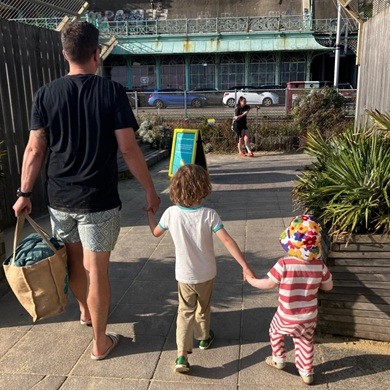
“I loved the job. But I have ADHD and a lot of energy, and I wanted a way of working that fits how my brain actually works, as well as one that gave me more time with the boys.”
“Three days a week has been the making of me. I ride my bike. I take long walks, which is where I do my best thinking. I see my sons. I am not tired all the time.”
“I also think it has made me better at the work. Part-time forces you to be reflective. I have the space to give a problem my full attention instead of a slice of it.”
“Every working day I start with a full tank. How many people in this industry can say that? Hire me for a project and you get the best three days I have, not five days of a slightly worn-out version.”
“Construction has some of the worst mental health figures of any industry, and one reason is that nobody talks about working differently. I would love to see more men in the sector say out loud that they work part-time and that it is working. We need more examples. Come on, men.”
Published October 2026
More part-time stories: