As a social business, we measure the impact of our work against clear social objectives, as well financial ones. Here’s a summary of our success.
By Melissa Jamieson, CEO, Timewise

Here at Timewise, we are proud to be a social business. We invest our profits back into our work, creating a virtuous circle in which we build on the insights we’ve gained to deliver better, more targeted solutions for our clients. And we share our learnings as widely as possible, to help drive change within and across as many sectors as possible.
As part of our social model, we set ourselves a suite of objectives against which we monitor the impact we’re having on businesses and individuals. And three years ago, we set some particularly ambitious goals, and committed to tracking our performance against them over time.
The outcomes are clear – and are set out in our latest social impact report , which also includes case studies and other feedback from businesses and individuals. But the topline summary is that we smashed our targets on all five measures.
For example, having set ourselves the challenge of working with 100 employers to influence their flex strategies and practice, we collaborated with 151. Having aimed to positively impact the lives of 1 million people through greater access to flexible working, we reached 1.7 million. And having a target of widening access to flexible working at the point of hire by posting 25,000 jobs on Timewise Jobs, we actually posted over 42,000.
So what does all this mean, overall? It means more individuals who want or need to work flexibly have been able to find a job to match their circumstances. For many people, such as those who are carers or have health conditions, this flexibility can be the difference between working or not. This in turn has a positive impact on societal issues such as child poverty.
It also means that more businesses now understand the role that flexible working plays within issues like talent attraction, retention, well-being and inclusion – and critically, understand what to do about it.
The result is a win-win-win scenario which benefits businesses and candidates alike. It increases the options for new candidates, and makes it easier for those already in work to move or progress, taking their flexibility with them. And it supports businesses to find, keep and nurture talented individuals, who are happier, healthier and more productive at work.
We’re publishing this report at a time of great uncertainty. The jobs market is hugely unsettled; companies are battling with a skills crisis, and with a marked candidate shortage. And the cost-of-living crisis is making it more important than ever that we help as many people as possible find work that fits with their lives.
So, having proved over the last three years that our work has measurable impact, we want to see action on a greater scale. And we’re calling for a shared commitment from businesses, government and social funders to invest in innovative solutions that will help make good flexible work available to all.
We need government to build an infrastructure that supports flexible options. We need businesses to develop change programmes that create the right flexible jobs for their structure and their people. And we need social funders to get behind organisations like ours, so we can explore what works and share our learnings to drive wider change.
We’re here to help, in an advisory or a practical capacity; please get in touch if you’d like to know more. In the meantime, having smashed our three-year targets, we’re evolving our approach and developing a new suite of goals that match where we are now. We’ll update you all about this in the next few months; watch this space.
Published October 2022
By Amy Butterworth, Consultancy Director, Timewise
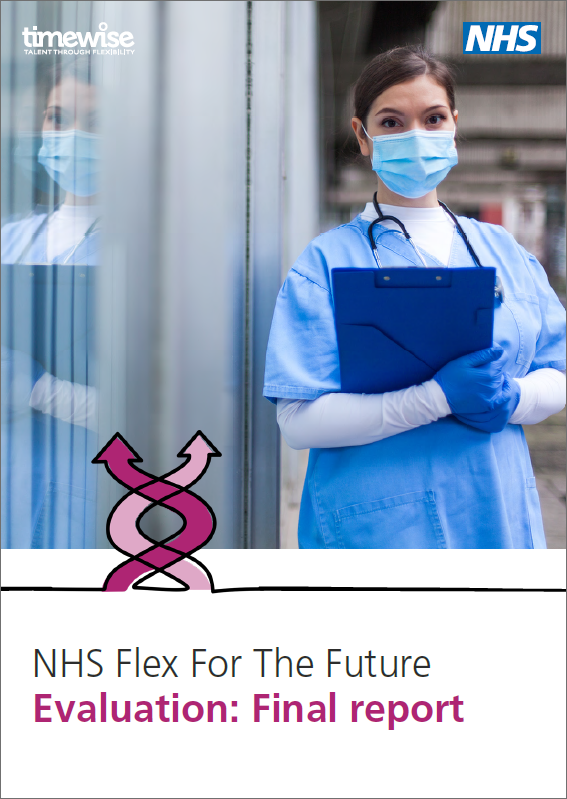
“We cannot afford to lose any more of our people.” As these words taken from the NHS People Plan make clear, the workforce crisis in our health service is now at an acute level. Recruitment and retention are more challenging than ever; data from earlier this year suggested that one in 10 nursing positions, and one in 17 doctors’ jobs, were unfilled. And in the last quarter of 2021, at least 400 NHS staff in England left their posts every single week due to inadequate work-life balance.
Faced with a mountain to climb, and believing that flexible working is a key part of the solution, NHS England and Improvement sought our help. They commissioned us to create a model for introducing and embedding flexible working practices, and to implement it at scale. The result was NHS Flex For The Future, the largest ever flexible working change project within the NHS, involving teams from 93 NHS trusts and organisations.
So what did we do? Well, as we know from our previous work within the NHS and elsewhere, there really is no one-size-fits all solution for an organisation of this size. We therefore began by tasking each trust to create their own change team, a group of at least five members of staff who knew what their specific challenges, barriers and issues around implementing flexible working would be.
We encouraged them to make sure that the change teams were representative of their trusts, and included frontline staff (such as nurses or midwives) as well as HR and OD professionals. This was critical, not only because they had first-person insights into how things work in practice, but also to ensure that any solutions were seen to be delivered from the ground up, not imposed from the top. We also asked each team to nominate an executive-level Senior Responsible Officer, who could fast-track any issues and decisions to the board, and hold senior colleagues accountable for supporting the programme and its outcomes.
Once the change teams were established, we worked to educate and upskill them through a six-month programme of workshops and advice. This included access to specialist speakers, real-time examples of innovative practice and case studies, as well as practical tools and templates to support the process. We also set up smaller, regionally based group clinics, where they could share ideas, challenges and progress with their local peers, supported by flexible working experts from Timewise and NHS England and Improvement.
Because of its scale, the programme also provided a valuable opportunity to gather information and insights that participants and the wider NHS could learn from. For example, we discovered a real disparity in data gathering around different flexible working patterns, which has a serious knock-on effect on reporting and planning within some trusts. Similarly, we discovered that while some trusts were advertising 100% of their jobs as flexible, others weren’t advertising any in this way. Towards the end of the programme, the change teams began to put what they had learned into practice by developing a business case with which to engage their leadership teams, and a tailored action plan that proposed the right solutions for their particular trust.
Of course, driving change within such large organisations is a marathon, not a sprint, and NHS Flex for the Future was very much the start of the process. Nevertheless, we are already seeing real shifts in attitude and approach from our 93 participant trusts and organisations.
70% of participants told us they have developed an action plan which was supported by their leadership teams. And as one participant put it: “The programme has helped me influence the board and not just start the conversation, but get an organisational objective on our 22/23 business plan.” There were also clear examples within our post-programme survey of how participants’ confidence and understanding has increased. When asked to respond to the statement, “I am clear as to the ways to increase the number of quality flexible roles in my NHS organisation” agreement increased to 69% (compared to 20% at the beginning of the programme). And for the statement “I understand how to design jobs with greater flexibility”, agreement increased from 30% to 74%.
We’ve also collated more detailed feedback about the impact of the programme through a set of case studies, which have really highlighted the positive impact of our work. To pick just one example, here are some insights from Fran Wilson, Lead Nurse for Attraction, Recruitment & Retention at Gloucestershire Hospitals NHS Foundation Trust:
I was already convinced that flexible working is an area that will increase staff attraction and retention, but now I have participated in the programme I have the insight, knowledge and resources to share with other people, which really helps.
We would never have got to present at trust board level without the programme, so it’s really helped raise the profile of flexible working… It’s also inspired us to start conversations from a point of yes, and how, rather than no!
It’s a big cultural change, so it isn’t going to happen overnight… but the progress we’re making is exciting… It’s been a great investment.
You can read Fran’s full case study here.
So, having educated and upskilled change teams from 93 NHS trusts and organisations, what’s next? The teams are continuing to develop and embed their action plans, and we are supporting some of them along this next stage of the journey. We’re also keen to help keep up the connections that were formed between teams from different NHS organisations, and will be looking to create more opportunities to convene organisations who are doing exciting things in this area – watch this space. In the meantime, having created and implemented this new model for change at scale, we’re eager to put it to good use, within the healthcare sector and elsewhere. If you are interested in starting a conversation with us about whether our change team model could work in your sector, please get in touch.
Published October 2022
By Emma Stewart, Co-Founder of Timewise

It’s well established that maternal worklessness is a core factor behind child poverty – and that flexible working helps parents and carers work. So, two years ago, the Scottish Government took the decision to join the dots, commissioning Timewise to improve access to fair flexible work for parents and carers, as part of their Tackling Child Poverty Delivery Plan.
Having carried out a feasibility study, we concluded that the only way to have the broad impact that the government required was to take a systems-led approach. There were already a range of labour market support services being offered to both jobseekers and employers, so we felt the most sensible route was to equip the intermediaries to advise on flexible working.
The result was Fair Flexible Work for Scotland, a two-year programme through which we created a network of Change Agents from 70 intermediary organisations (including recruiters, enterprise agencies and local authority employability teams), and trained them up to offer the right support. We also connected them to a range of wider experts on flexible working, including the Scotland-based Flexibility Works.
For employer-facing intermediaries, our focus was on how to help businesses adjust to new ways of working (including hybrid) and upskilling hiring managers to create better flexible jobs. For those who were jobseeker facing, we explored the best way to deliver advice for people (particularly parents and carers) on finding quality flexible work.
We achieved this through a series of interactive workshops and a toolkit of resources, as well as access to follow-up clinics tackling specific challenges and opportunities. We backed these up with up-to-the-minute data on the jobs market, via a new Scotland Flexible Jobs Index. And we also provided practical masterclasses directly to over 600 employers, offering clear guidance on how to improve their flexible working offer.
So, did it work? The answer is a resounding yes, across a variety of measures.
Initial feedback showed that we have succeeded in equipping our Change Agents to incentivise and support action on flexible working. Highlights include 80% saying they have a better understanding of how to influence employers to enable a fairer, more successful approach to hybrid working, and 76% strongly agreeing that “I am motivated to take action to ensure fairer access to flexible work by more people.”
We’re also pleased to note that the system is already becoming hardwired into how people operate; for example, Scottish Enterprise advisers now ask that any jobs created as a result of their business growth grants are advertised as flexible from day one.
And there’s qualitative evidence of emerging changes in approach from both employers and individuals, with even traditional employers such as the Scotch Whisky Association now offering a range of flexible arrangements for existing and prospective staff.
So what’s the secret of this programme’s success? Certainly, the participants feel that there is real value in this kind of collaborative approach, which brings together stakeholders from both the public and private sectors. And the systemic way the programme has been designed also makes it easy to share what works and scale up its impact.
The Scottish Government agrees too. This approach – supporting labour market intermediaries to not just advocate for, but provide, practical support on flexible working – is a key factor in encouraging Fair Work in Scotland. And, as the Fair Work Criteria now includes a specific request for companies accessing any government funds to offer flexible working from day one, it’s more relevant than ever.
Employers are (rightly) being asked to deliver on metrics around employability, inclusion and wellbeing, but they don’t always know where to start. This model doesn’t just set expectations; it also provides support, building systems capability that can then be maintained and rolled out more widely through existing intermediaries
So we’ll continue to monitor the impact of the support provided by this new network of Fair Flexible Work Change Agents, to build evidence of the effect it has on unlocking a better quality flexible jobs market, and the impact this has on tackling child poverty. And having proved the concept in Scotland, we’re now keen to replicate it elsewhere in the UK. We’re currently discussing it with some local and combined authorities in England, and are keen to get cracking; we’ll keep you posted.
Published September 2022
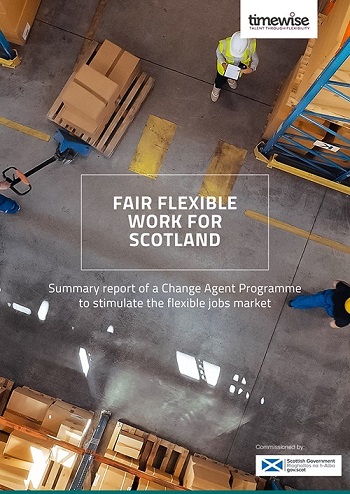
In 2020, we were commissioned by the Scottish Government to help improve access to fair flexible working for parents and carers, as part of their Tackling Child Poverty Delivery Plan. Having carried out a feasibility study, we concluded that we need to take a systemic approach, equipping intermediaries who were already working with job seekers and employers, so they were able to advise on flexible working.
The result was Fair Flexible Work for Scotland, a two-year programme through which we created a network of Change Agents from 70 intermediary organisations. We trained them up to offer the right support, as well as connecting them to a range of wider experts on flexible working, including the Scotland-based Flexibility Works.
This report sets out how we carried out this work, and shares the positive outcomes from the programme. It’s fair to say that it was a resounding success; highlights include 80% of participants saying they have a better understanding of how to influence employers to enable a fairer, more successful approach to hybrid working, and 76% strongly agreeing that “I am motivated to take action to ensure fairer access to flexible work by more people.” We will continue to monitor the impact of the support that the Change Agents are providing, and are currently exploring the potential of replicating this model elsewhere in the UK.
Published September 2022
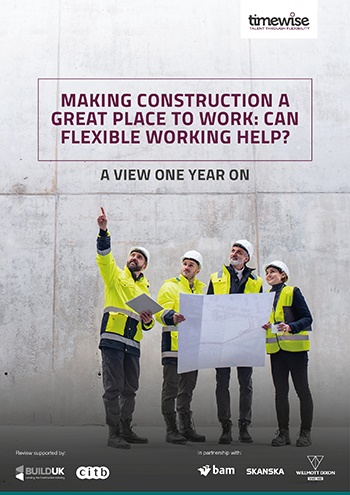
In the summer of 2021, we published the report on our Construction Pioneers Programme; and people across the industry sat up and took notice. The programme demonstrated beyond any doubt that it IS possible to introduce flexible working for on-site roles, and that the benefits of doing so are clear.
One year on, we have gone back to our Construction Pioneers to review their progress; and the good news is, flexible working is continuing to be a success story for all four firms. They have rolled out and built further on the learnings from the programme, with no detrimental effect on budgets or timelines and with plenty of positive impact on staff well-being and performance.
Additionally, our Pioneers believe that that flexible working has been a key contributor to a huge reduction in sickness absence – by over one third in two of the firms. They are also reporting increased productivity levels through the use of hybrid working, which they feel is the result of having a happier workforce better able to manage their commitments outside of work.
This review explores our Pioneers’ progress against the recommendations from our 2021 report. It highlights the impact of the changes they have made, and shares insights from leaders about what works. And it also sets out what needs to happen to cascade these learnings across the industry as a whole.
Published July 2022

It’s no exaggeration to say that the teaching profession is in the middle of a staffing crisis. Research from the National Education Union suggests the 44% of teachers are planning to leave within five years, and that it’s getting harder to fill vacancies, with a knock-on effect on workloads and wellbeing for remaining staff.
Introducing flexible working in teaching is less straightforward than in office-based roles, for a range of reasons. Complications around timetabling and culture, the frontline nature of the role and the intensity of the school day all play their part.
But all the evidence suggests that the positive impact it has on staff retention and recruitment makes it well worth the investment. The reasons why schools should implement flexible working are clear; what’s been less certain, until now, is how do it well.
Our Teaching Pioneers Programme sought to close this knowledge gap. Working with eight secondary schools, within three MATs, we spent 16 months exploring how best to champion and deliver flexible working within the profession.
Our learnings from the programme, and the implications for schools, academy trusts and policymakers, are set out in a full report, which you can download below. You can also download a guide, based on what we learned, which provides practical support for headteachers.
Published June 2022
With Covid restrictions now lifted across the UK, most organisations are opting for a hybrid blend of in-office and home-based working for non-frontline employees. But because of the in-out nature of the last two years, there has been limited scope to measure what works best.
At Timewise, we are curious about what has really changed, and how much will stick. We are also acutely aware of the inclusion and equity risks of poorly implemented hybrid arrangements, especially for key groups and frontline employees. And we believe that, in order to move successfully to a long-term hybrid model, organisations first need to understand how it is working on the ground.
It’s for these reasons that we have created our report, Beyond the hype of hybrid. Developed with the support of 14 organisations at varying stages of hybrid implementation, it explores the risks, challenges, benefits and successes of today’s on-the-ground hybrid practices, and sets out three critical priorities for businesses to focus on going forwards.
The report also includes advice from experts within the tech, legal and facilities sectors, and shares recommendations from Timewise about what businesses should do next to make the reality of hybrid live up to the hype.
In frontline sectors, which often run on tight margins and with an acceptance that staff churn is high, it’s particularly difficult to make a business case for investment in flexible working. But frontline workers have borne the brunt of the pandemic, whilst seeing other workers reap the benefits of increased homeworking and flexible hours. In the face of acute skills shortages, employers need to level up by seeking flexible solutions for frontline workers, or risk losing even more of them.
Following on from successful pilot programmes in five frontline sectors (retail, construction, social care, teaching and the NHS), Timewise commissioned the Institute for Employment Studies to undertake a break-even analysis of investing in flexible working. IES calculated how quickly the benefits of improved retention and reduced sickness absence could offset the costs of a typical programme.
The findings make a strong case: within just a few years, savings begin to outweigh the costs of implementing flexible working, and begin to deliver financial returns.
We hope this powerful analysis will help fill the evidence gap on flexible working ROI, and provide the impetus for employers and policymakers to prioritise investment in changes to working patterns, for the benefit of business, the individuals they employ, and society as a whole.
Published April 2022
The Greater Manchester Good Employment Charter sets a high standard for jobs in the region, promoting practices that support diversity and inclusion, and encouraging fair pay. Flexible working is a core part of the charter, and this report by Timewise looks at how well the region is doing when it comes to openly offering flexibility at the point of hire.
The answer is: very slightly better than the national average (at 27% versus 26%), but with some interesting granular differences. For example, in Greater Manchester, flexibility is most available in jobs paying over £60k. This is in sharp contrast to the UK as a whole, where flexibility (mainly in the form of part-time arrangements) has always been most available in low-paid jobs.
And home-working, which is now commonplace for office-based staff, is being offered in only 11% of the region’s job adverts.
There is a clear need for employers in Greater Manchester to do more, and faster. Flexible hiring can reach a wider talent pool – essential in today’s challenging jobs market, where applications are in short supply.
More importantly, flexible working is essential to creating fairer, more inclusive workplaces. It should need no explanation that inclusivity must start at the point of hire, and not be restricted to existing staff. Nor must it be restricted to certain types of jobs or salary levels.
We hope that the Flexible Jobs Index for Greater Manchester will inspire the region’s key anchor institutions to champion flexible hiring as part of their wider inclusive growth strategies. And we hope it will galvanise Greater Manchester employers to consider flexible working as a matter of routine when they advertise jobs – alongside salary, pension and other benefits.
The event was hosted by our Development Director, Emma Stewart, and featured a panel of business leaders who provided their own insights and analysis about what they’re seeing on the ground, as well as their suggestions for what needs to be done to shift the dial. We’ve included a recording of the event below.
Among the key themes which emerged were:
Our thanks got to our panel for sharing their insights and experience: Neil Carberry, CEO, The Recruitment and Employment Confederation; Jonny Briggs, Head of Talent Acquisition and D&I, Aviva; Farrah Ekeroth, Head of Employer Brand, EY and Jane Galloway, Head of Flexible Working, NHS England.


