Successful management of remote and hybrid teams requires a new set of skills – and they won’t just appear by magic. Leaders and HR need to invest in training to bring people up to speed, or risk the consequences.
As 2020 crawls to a close, one thing is certain; the workplace will never be the same again. It’s pretty clear that a degree of remote working is here to stay; a survey by the IOD suggested that 74% of firms are planning to maintain the increase in home working. And at the time of writing, the Prime Minister has told all workers in England to work from home if possible until April 2021.
Clearly, there are many upsides to remote working; from the time gained by skipping the commute and the related positive impact to mental health, to a general perception that it makes it easier to balance work and life. And the growing acceptability of hybrid working set-ups, where you work in the best place for the job in hand and the needs of your team, is a real step forward.
But it’s also important to recognise that the remote working we’re seeing right now isn’t normal; it’s universal, and enforced, without reference to whether it’s the best way to tackle that day’s or week’s workload. So it’s not surprising that, in our conversations with businesses, we’re hearing lots of examples of how it isn’t working as it should.
This doesn’t mean that home and hybrid working arrangements should be phased out once the pandemic is over. Employees want to keep them, and they can be a useful part of any organisation’s flexible toolkit. But simply replicating office-based practices isn’t enough. As with any flexible role, these arrangements need to be designed properly, and managers need to be skilled up to support the people who are using them.

The concept of Zoom fatigue – the exhaustion felt by people as a result of online meeting overload – was much discussed at the beginning of the pandemic. Some employees, particularly younger ones and those living alone, have wrestled with a lack of proper workspace, with some even reporting feeling judged by their home environments. The blurring of boundaries is also a recognised problem. And smart decision-making and creativity have both been noted as being negatively affected when whole teams work permanently from home.
Additionally, there is a growing sense that, without careful oversight, the move to a hybrid set-up, with some in the office and others at home, may lead to women and ethnic minorities being excluded from key decisions and limiting the diversity of opinions which are heard. Or that the extroverts in a team will choose to go in, and the introverts to stay at home, affecting their visibility and progression path, and encouraging groupthink.
These are tough issues to work around – but if we just roll over and accept them as the price we pay for more flex, we risk rowing back on all the progress that’s been made. Instead, we need to tackle them – and the best way to do so is by making sure line managers and other leaders are properly skilled up.
Well-trained, properly skilled managers know that they need to trust their remote employees, rather than force them to stay logged in to Zoom all day so they can keep an eye on them. They understand that having an 8.30 meeting every day to check that everyone is working can be counterproductive. They appreciate that, when physical interaction isn’t possible, other ways of connecting teams have to be found. And they realise that, in an era of job uncertainty, employees need to be encouraged to switch off, not left to put in ever longer hours for fear of being let go.
To succeed, managers need to know how to design flexible roles – whether part-time, remote, or a combination of the two. They need to understand how to manage flexible employees, and how to ensure that hybrid-working teams are still able to work productively together. But these aren’t skills that people can just pick up. They need to be taught; and that’s where we come in.
Training managers to build and develop successful flexible teams has long been a core part of our work here at Timewise. And now, from our work with clients and other organisations during the pandemic, we have gained a unique set of insights that are specifically relevant to building these skills in the current circumstances.
We can support employers in a range of ways; from workshops and training sessions to participation in our new Flex Positive Programme. So if you, like us, believe that this is a critical time for developing the leadership skills that will make a success of flexible and hybrid working, feel free to get in touch to see how we can help.
Published December 2020

The Scottish government was serious about improving access to fair flexible working long before the Covid-19 pandemic hit. Recognising the role that flex can play in tackling inequality, and keen to help employers attract and keep talented people, they commissioned a Flexible Jobs Index for Scotland in 2017, and subsequently asked us to explore how to improve access to flexible work.
And now, as Scottish organisations look to recalibrate their workplaces in response to the pandemic, the government is stepping up their support – and has asked us to work with them to do so. The result is our Fair Flexible Work programme, which launches in Scotland this month.
It’s now widely agreed that flexible working benefits employers as well as employees. There’s a strong social case for it, as a way of opening up the jobs market for vulnerable groups, including parents, carers and those with mental and physical health issues. And the business case, including the pivotal role flex plays in attracting and retaining a diverse talent pool, and closing the gender pay gap, is no longer in doubt.
However, despite the benefits, there are still too few quality flexible jobs available; the 2017 Flexible Jobs Index for Scotland noted that just 11.9% of vacancies paying more than £20,000 FTE referenced part-time or flexible working. With 87% of the UK’s workforce either having or wanting flexibility in their next job, there’s a clear gap here, which employers who want to recruit the best people need to close.
Within the context of the Covid-19 pandemic, improving access to flexible working is all the more critical. On the plus side, the crisis has ripped up the rulebook on what ‘normal’ work looks like, and opened up opportunities for change. Leaders and managers have learned that they can trust their employees to work from home without damaging productivity. 40% of medium to large employers have said they will permanently increase remote working options, and 13 million people plan to ask for permanent flexible working arrangements going forward.
But as well as these opportunities, the pandemic has created some serious risks, for employers and for employees. The impact on the economy and the rise in unemployment are creating huge challenges; between May and July, Scotland’s unemployment rate rose to 4.6%, a higher rate than that of the UK as a whole. And while the increased acceptance of flexible working is great for those who can take advantage of it, it’s just not possible in some sectors.
Frontline roles, such as those of the NHS staff and retail employees who were so appreciated during the crisis, cannot easily be made flexible. So if we don’t take action, we will end up with a two-tier system in which only those who work in an office-based environment can access the benefits of flex. And the knock-on effect of this will be to increase workplace inequality, and deny flexibility to some of the people who need it most.
For all of these reasons, our new Fair Flexible Work programme is happening at the perfect time. A three-stage, eight-month programme, it will provide employers in Scotland with the knowledge, insights and tools they need to take advantage of the opportunities that flexible working delivers, and stops the risks becoming realities.
The first stage of the programme will take place in October, and will see us providing a series of webinars, guidance and toolkits for hundreds of employers across Scotland. Through these platforms, we will share our insights and experience on how to adapt to the crisis, and offer practical support with creating and delivering sustainable flexible roles.
We will also be working with a range of Scottish industry bodies, including the CIPD, the CBI , Scottish Enterprise and Glasgow Chamber of Commerce, to create a network of Fair Flexible Work Change Agents, so they can better support their employer members to embrace new ways of working. This will include training on the job design, culture change and team management skills that support flexible workers and create flexible workplaces.
And finally, in the spring of 2021, we will publish a new Flexible Jobs Index for Scotland. This will assess the proportion of flexibly advertised roles across different wage brackets and sectors, and will also use pre- and post-pandemic data to see whether Covid-19 has shifted the dial on flexible recruitment.
There’s no question that this is a large-scale programme of work, and it’s one which we will relish, not least because the outcome is so worthwhile. It’s a once-in-a-lifetime opportunity to reshape working practices across the whole of Scotland, to help employees have fair access to flexible work and to help organisations skill up and take action on flex that will make them employers of choice. We can’t wait to get started.
Published October 2020
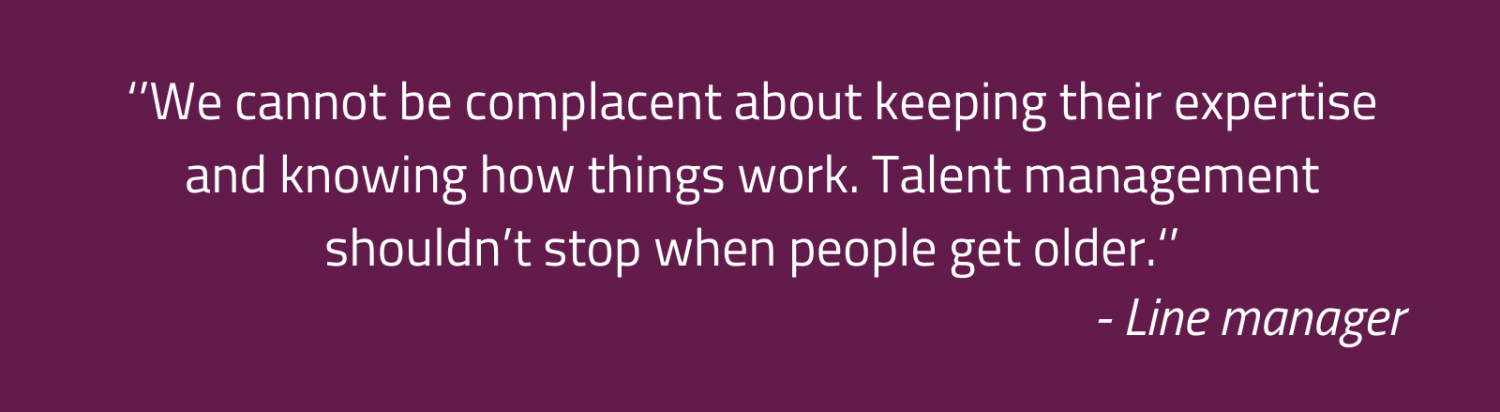
The over 50s now stay in work longer, because they want or need to. They increasingly have to balance work with the changes that come with ageing (from physical changes to a desire for more control over how they spend their time). And they make up a third of the UK workforce.
Employers value the experience and skills that over 50s bring to their roles. But the power of flexible working as a retention tool for this demographic has not been given the same level of attention as it has for other groups such as working parents.
Timewise therefore partnered with the Centre for Ageing Better to explore how employers could best support older workers through flexible working. The key findings of the project are reported below, together with details of the methodology.
Although the mechanics of implementing flexible working are the same for all demographics, ‘what happens at the edges’ can be different for older workers:
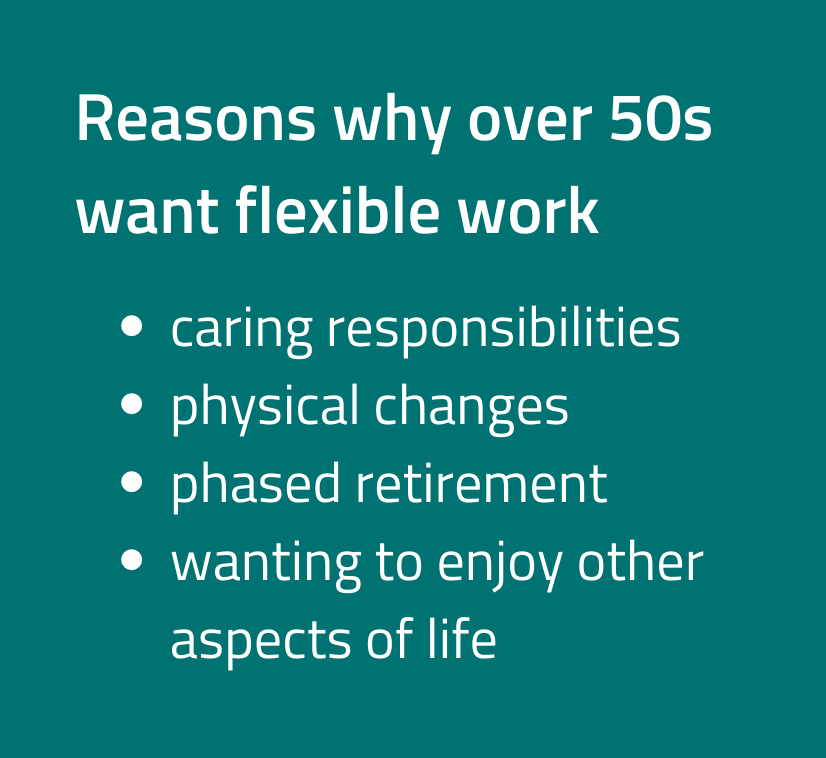
Appreciating the needs and wants of over 50s will help to engage them in conversations about flexible working, and retain their skills and experience.
Our research and pilot programme explored feelings around whether there was a ‘hierarchy of acceptable reasons for working flexibly’. Both managers and staff felt that:
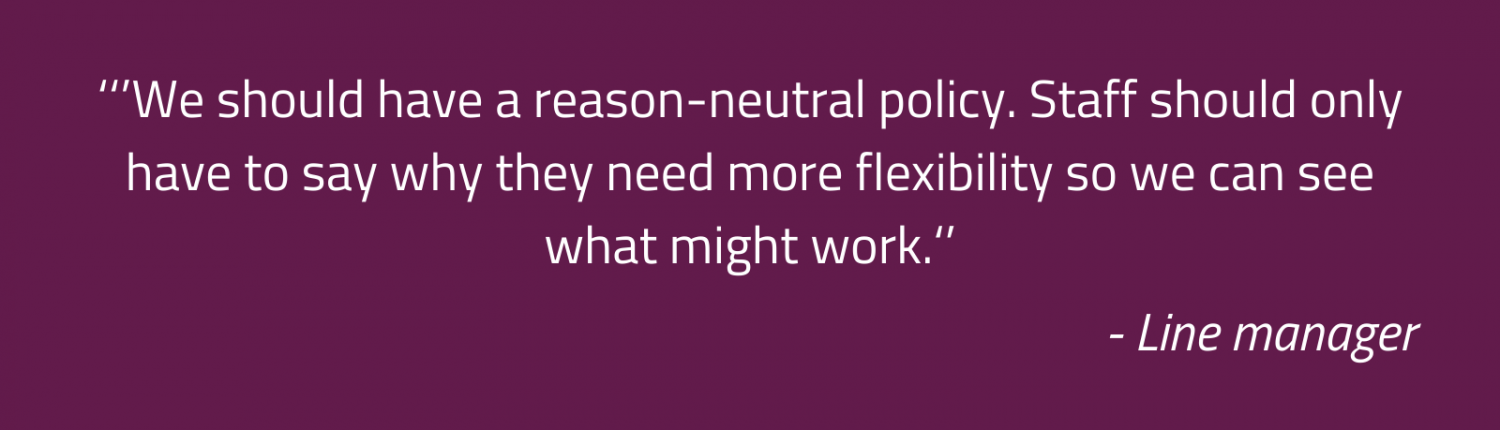
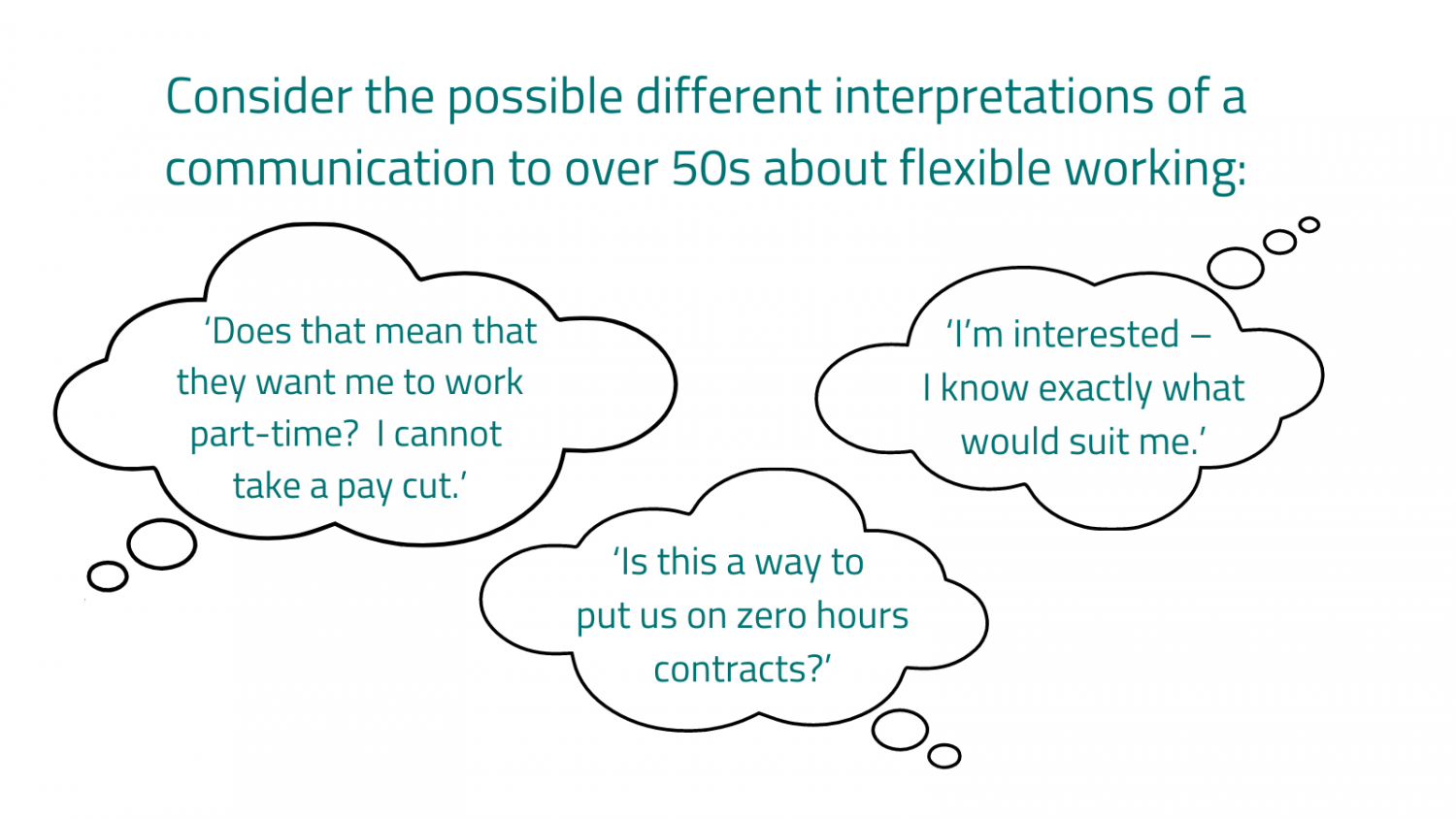
Flexible working initiatives aimed at older workers need to be carefully managed to ensure there are no perceptions of age discrimination. It’s important for employers to pre-empt how different people may respond, and factor this into communications. The best way to support flexibility for over 50s may be to make it:
Either
Or
This was an 18-month programme in two-phases:
Insights research: The first phase consisted of focus groups and surveys with six large employers: Guy’s and St Thomas’ NHS Foundation Trust, Leeds City Council, Legal & General, McDonalds, Sodexo and Whitbread. We spoke to more than 40 over 50s staff from these organisations, as well as 34 managers with older workers in their teams. We also ran a survey for the over 50s, with 421 respondents, to understand attitudes and perceptions about work-life balance and flexible working, and to gain an insight into their lived experience. This was conducted between November 2018 and February 2019.
Employer pilots: Our research was followed by pilots with Guy’s and St Thomas’ NHS Foundation Trust, and two divisions at Legal & General. The purpose of the pilots was to bring about changes in working patterns for a cohort of over 50s, providing them and their managers with the training and tools to implement and adapt to different flexible working patterns. This part of the programme ran from May 2019 to February 2020, and was completed prior to the covid-19 pandemic.
Published September 2020

The coming of the multi-generational workplace has long been anticipated – and, according to the numbers, it’s arrived. One in three of today’s workers are aged over 50, and that proportion is set to rise; many people plan to work longer, either because they want to or need to. And employers can benefit from the skills and experience that they bring to their roles.
But despite the growth in numbers, the individual implications of ageing, and how they play out in the workplace, are not always understood or explicitly recognised. And nor is how the ageing process affects what an individual needs or wants from their job role.
So how can we make sure that employees continue to be supported, and valued, as they grow in age? According to the over 50s themselves, here is one workplace practice above all others that would allow them to work successfully for longer: flexible working. And as we all grapple with the long-term impact of the Covid-19 pandemic, this issue is all the more relevant.
Over 50s are likely to be more vulnerable to the virus than their younger counterparts; many also have caring responsibilities which make the ‘return to normal’ more complex. So making sure that these older workers have flexible working options is now more important than ever.
It’s for this reason that we partnered with the Centre for Ageing Better, and a range of employers, to explore how best to support older workers with flexible working.
We carried out research to understand their reasons for wanting to work flexibly and identify the barriers that were standing in the way. We also ran pilots with two employers to explore new ways to overcome them; you can download the full report here.
By Emma Stewart, Co-Founder, Timewise

It’s no secret that the teaching profession, is struggling to recruit and retain the teachers it needs. Pre-Covid-19 data indicated that targets for the required number of secondary school trainees had been missed for the last seven years, and that 33% of state school NQTs leave within five years. And although the pandemic appears to have triggered a spike in graduate teacher training applications, it’s not yet clear whether this will last – or be enough to bridge the gap.
While it isn’t the only factor behind the teaching brain drain, the lack of flexible teaching roles compared to other sectors is likely to play a part. Indeed, there is evidence to suggest that some teachers leave the profession because they can’t access flexible working; and that many secondary school teachers who do leave reduce their hours when they do so.
In fairness, it’s true that teaching roles are not easy to make flexible; there are a range of barriers, such as timetabling, budget constraints and the student-facing nature of the role, which are all complex to overcome. However, we believe that no sector is un-flexable; we specifically set up our Innovation Unit to tackle these hard-to-fix sectors, and show what can be done.
So, on that basis, and following on from our 2019 report on building flexibility into schools, we are launching a new action research project for the teaching sector. Working in partnership with three large multi-academy Trusts (MATs) and supported by education specialists Talent Architects, we’ll start by exploring the barriers in more depth, as well as building on the insights that these schools gained during Covid-19, and seeing what positive experiences can be taken forward. We’ll then use our learnings to design flexible roles that work around or overcome these barriers, and pilot them within schools.
The project, which is being supported by Barclays Life Skills and Browne Jacobson LLP, will last a year; we’ll post updates about what we’re learning along the way, as well as a full final report. In the meantime, if you’d like some initial inspiration, take a look at our case study of a school with a hugely successful track record in this area, Huntington School in York, where more than half of teachers work part-time.
Right now, though, schools like Huntington are in the minority, and they are having to work it out for themselves. It’s our hope that this project will deliver a clear roadmap for schools for designing and delivering flexible teaching roles, so that wherever they are, whatever their size, they can attract and keep teachers by offering the flexibility they need and want.
Published September 2020

The statistics around teaching staff shortages are well known, but they bear repeating. Data from the NFER has indicated that targets for the required number of secondary school trainees have been missed for seven years in a row, and 33% of state school NQTs leave within five years. And while the Covid-19 crisis appears to have triggered a spike in graduate teacher training applications, it’s too early to say whether this will deliver sustainable growth.
Yet it is possible to buck these trends. There are a number of schools who are managing to hold on to their experienced staff at far higher rates than others. Step forward Huntington School, a community secondary in York, which has a miniscule staff turnover rate of 7%. Around half of teachers work part-time – including members of SLT – on contracts ranging from 0.2 to 0.8 FTE, and there are several job shares.
So, what’s the secret? According to Headteacher John Tomsett, it’s all about the culture. John’s philosophy is that good schools don’t just pop up overnight; they grow over time out of a supportive culture, led by the leadership, that guides the school’s vision in the right direction.
In practice, at Huntington School, this means busting the myth that part-time teachers have a negative impact on students, and that the timetable can only accommodate a few part-time jobs. It means understanding that happy teachers stay, and that supporting the other aspects of their lives allows a school to get the best out of them. And it means taking a positive, proactive approach to flexible working, with a process built on the presumption that “We will make it work.”

It’s becoming clear that, when the workplace gets back to ‘normal’, it won’t look like it did before. The crisis has challenged the concept of the office being the best place to work. And employees in all kinds of roles, whether office-based, frontline or elsewhere, have seen for themselves the benefits of working flexibly or reducing their hours.
The knock-on effect of this is an increase in demand for permanent flexibility. A recent survey suggested that 13 million people plan to request changes to their long-term pattern once the crisis has subsided.
Is this something employers should fear? On the contrary, we believe this is a catalyst that will change workplaces for the better. And so instead of worrying about opening the floodgates, leaders and managers should see this as an opportunity to be proactive, and encourage their staff to explore their options in a way that will work for the business.
It’s for this reason that we’ve created a free toolkit for employees, Beyond lockdown: How to negotiate flexible working, for the long-term . It’s part of our free Covid-19 support programme, and will help individuals understand the different flexible working options, explore which best match their role, and think through the impact on their team and the wider organisation.
Sharing this toolkit with your employees will help them consider the issues and potential solutions before they bring their request to their managers, which should lead to really positive conversations. It will also encourage them to ask for a flexible working pattern that benefits the business as well as themselves.
And critically, being proactive about offering this support will demonstrate that you’re a forward-looking, proactive employer who puts staff wellbeing at the heart of your strategy. In the post-Covid landscape, where organisations may be judged on their response to the crisis, that’s a powerful position to be in.
Our free Covid-19 programme is supported by Barclays LifeSkills and Trust for London.
Published June 2021

The current crisis has been described as ‘full-time work meeting full-time life’; a remote working experiment that we’re all having to work through. So how are employers supporting their employees during Covid-19 – and what should they do next?
We recently co-hosted a session for Timewise Partners, in which we explored how different companies are managing the status quo, and provided a mixture of short-term practical guidance and long-term issues to consider. Here are the highlights.
Among the insights we shared with our partners were these snapshots of workplace life during Covid-19:
Our attendees shared a number of examples of good practice from their organisations. These included:
Leadership and management
Changes to processes
Information and resources
Mental health and wellbeing
Planning ahead
We also shared four core principles to help employers take the right next steps to support their employees:
(1) Think about WHAT people are doing
Assess what work needs doing, right now. Set priorities, new objectives and expectations for what needs to be done, before working out how to do it differently. Recognise the backdrop to people’s current working lives and consider the balance between the business’ needs and individuals’ needs.
(2) Think about WHERE people are working and how to support them
Consider providing enhanced broadband or a proper office chair. Create space for collaboration and engagement such as virtual team meetings and remote cafes, and check in on anyone who goes under the radar. Note what’s working and what isn’t to ensure you take the best examples with you into the long term.
(3) Think about WHEN work needs to be done and how that matches with people’s needs
Some people may be splitting childcare with a partner and so may need to have blocks of time off. Others may need to get ahead at the weekend to allow more breaks in the week. Build a framework that looks at your organisation’s needs and each individual’s needs to identify working patterns that will suit both parties.
(4) Think about HOW MUCH work needs doing and can be managed at the current time
Some employers need staff to reduce their hours to save costs; some employees need to work less to juggle their other commitments. In order to make this work, leaders need to either reduce the workload or find alternative resource. Expecting people to do the same work in less time isn’t a sustainable option.
We also shared our thoughts on the opportunities and risks coming out of Covid-19 and what employers need to do to mitigate the negatives and make the most of the positives.
As the situation continues, we’re keen to gather and share more stories about what’s working and what’s not, so more businesses are able to come out of Covid-19 into a more flexible future. If you have any insights to share, or need support from the Timewise team, do please get in touch.
Published April 2020
By Kevin Green, Interim Chair, Timewise Executive Board
It’s becoming increasingly clear that many of us will be working from home for a significant period of time. It’s also likely that many managers will be leading a completely remote team for the first time.
This situation was no doubt thrust on both parties with little time to think, talk or prepare for this new way of working. And it will call for managers to operate very differently.
We know that the way we engage and communicate with each other when people physically work together is often informal. Great managers understand their people, and can pick up on changes by observing both individual and team behaviour. However, both of these become much more challenging as people work from home or remotely.
But there is a massive, positive opportunity here. 80% of people who work remotely say that if it’s done well, their engagement and morale improves; and 62% say they feel more trusted. This is therefore an opportunity to be grasped.
Here are my six top tips to help you support and inspire your remote team.
In times of crisis and change, people look to their managers and leaders to provide clarity, support, guidance and direction. True leaders will step forward, recognising the importance of their role. And they will start by reinforcing why the work the team does is important.
The more this work is aligned to a compelling purpose, the better, as this creates meaning. Leaders who are good at this get their people excited about what they are doing and why it’s important. They need to walk the talk and be visible and available to their teams, but they also need to demonstrate energy and the ability to make tough or difficult calls.
A leader’s true values will be thoroughly tested under pressure. After all, it’s relatively easy to live your values when times are good. But when success and results hang in the balance, an authentic leader will demonstrate what they are prepared to sacrifice and the trade-offs they are willing to make. Leadership is about putting your team first and yourself second.
It’s important to set clear expectations about this new way of working. This includes your expectations of people’s availability and accountability as well as how often team and one-to-one conversations will take place.
My advice is to do generic scene-setting with the whole team so they all hear it together at the same time. Make sure there is plenty of time for questions, and remember to ask for ideas. How can we make this work together?
Then, have a one-to-one conversation with each member of the team about their specific deliverables, what you expect of them and by when. Clarity is important, but so is giving people the space and opportunity to share ideas, ask questions and explore the issues; it avoids misunderstanding and difficulty later. So don’t rush the process.
Team communication is an important part of a leader’s role in any circumstances; but when everyone is working remotely, it becomes critical. So you need to recognise that you should spend more time talking, listening and engaging with your people –it’s important people feel connected.
First, if at all possible, use video rather than conference calls. If you can’t, use conference calls rather than the dreaded email, which has so much potential there is for misunderstanding. The opportunity to use video is a godsend in the current situation, and is so much easier today thanks to tools such as Zoom, Skype and Google Hangouts.
Over 60% of communication is non-verbal, so seeing people as they talk enables you to pick up on these signs. Keep the team communicating as a whole. Continue with regular team meetings; indeed, to support this new way of working, you may want to increase their frequency –perhaps starting with twice or three times per week. This will help people get comfortable and allow them to test how it works for them.
Make sure you allow time for small talk, too; people may be feeling isolated or even lonely after several days with little social contact. A good way of doing this is to get everyone to check in (say how they feel at the moment) at the start of the meeting.
It’s also a good idea to carry on doing creative and brainstorming sessions with the team, asking for ideas or solving problems together, This will enable your team to feel connected and that they are making a collective contribution.
One-to-ones must continue and, as with general team meetings, you may want to do them a little more regularly to start with. Ask lots of questions to find out what’s going on for each individual. Share agendas in advance, and make sure you know what you’re going to be covering.
Preparation is even more important for conversations over the phone or video, as they tend to be shorter and more business-focused. Listen actively to what’s being said and try to avoid assumptions and talking over other people. Ask questions to clarify what’s meant, so you’re not talking at crossed purposes.
It’s important to foster friendships among the people that work for you. Apart from formal calls and meetings, encourage your people to have informal calls with each other to help them stay connected. We know that people feel more engaged and passionate about their work if they have workplace confidants and supporters. This may disappear during remote working if it’s not encouraged.
People go to their work friends when they need help or want to celebrate or commiserate about workplace things. In the absence of that support, work can feel lonely and isolating, and lacking attachment. However much we like what we do, we won’t be fully energised or motivated if we don’t have close and supportive relationships at work.
A study by Harvard Business Review showed that remote workers are far more likely than on-site employees to worry that co-workers say bad things behind their backs, make changes to projects without telling them in advance, lobby against them and don’t fight for their priorities. Be a leader who encourages a culture of open positive friendships among co-workers — this will avoid these concerns becoming a reality.
Be responsive and available to your team. Set aside time in your calendar when you’re happy to be contacted, so your team know they can catch up with you on anything.
One thing that really makes people feel distant is the communication time-lag. If they have to wait hours for a response to something they are working on, or an idea they have, whether it’s right or wrong, people feel it’s not important to their manager.
By setting time aside where you’re available online or over the phone to provide feedback or insight instantly helps people feel recognised and listened to.
Many of the things I’ve proposed here will feel unnatural to start with. But if you persist, then there is no reason why your team shouldn’t be as productive, creative and energised as if they were on-site together. In fact, you may even find that they perform better and deliver better results working this way. From adversity comes opportunities; let’s grasp them.
Published April 2020

One of the most visible examples of the impact of coronavirus on the workplace is the growth of remote working. And as we’re flexible working specialists, you’d imagine we’d be delighted. But while it’s great to see companies adapting to the need to work together while apart, it’s time to take stock of where we are – and where we might end up. Are all the changes we’re seeing for the better – and will they last?
It’s certainly true that there are a number of positives coming out of the crisis. On a societal level, as an organisation who has been working to support work-life balance for nursing staff, we feel the outpouring of appreciation for NHS employees is long overdue. And we sincerely hope that their value, and that of other frontline workers such as teachers, retail staff, government employees and carers, who are putting themselves at risk for all our sakes, continues to be respected and rewarded once the crisis is over.
Additionally, on a practical level, this enforced experiment in remote working has overturned some long-held objections to remote working, creating real opportunities to change the narrative:
It’s our hope that, as a result, the reasons traditionally given for not allowing remote working just won’t wash. And so the debate can move on from whether it should be used to how to make it work – and the focus onto practical solutions such as job design and culture change.
However, there are also some ways in which the impact of coronavirus is more negative. For example:
And of course, we also need to beware the assumption that this is a temporary response to Covid-19, and that everything will go back to normal once the restrictions are lifted. Despite the pitfalls outlined above, I very much hope that isn’t the case.
Indeed, I’d argue that there is no normal to go back to. I believe that some of the more positive experiences caused by the impact of the coronavirus – avoiding the commute, spending more time with family and being able to work at times that suit us – will encourage employees to push for greater flexible working. And forward-looking employers will need to incorporate it as part of their offer.
If that’s the case, what should employers do to set the right tone, right now? Here are three good ways to start:
Here at Timewise, we’re already exploring the best way to turn the impact of coronavirus into a positive force for change. We’re creating a programme of webinars, training sessions, toolkits and advice for employers, with two core aims:
It’s a challenging time right now; no question. But it’s also an opportunity to change workplaces for the better, for good. If you’d like to know more about the programme we’re building, or need support with any of the issues I’ve noted here, do please get in touch.
Published April 2020


