Labour's promise to create a "right to switch off" could be what we need to support better work-life balance and wellbeing. But how will it work in practice?

By Nicola Pease, Lead Principal Consultant
With the publication of the Employment Rights Bill, it was anticipated that the right to disconnect would be one of the raft of new rights for employees. However, it seems that this particular element of the legislation will instead be progressed through a Code of Practice. Although it will not become a statutory right, it remains a key pillar of Labour’s plan to Make Work Pay. In this article, we’ll explore what it’s likely to mean for employers and workers, and how best to prepare.
The government’s intention behind this new Code of Practice is to improve productivity and morale and promote work-life balance. The commitment is set out as follows:
“We will bring in the ‘right to switch off’, so working from home does not result in homes turning into 24/7 offices. We will follow similar models to those that are already in place in Ireland and Belgium, giving workers and employers the opportunity to have constructive conversations and work together on bespoke workplace policies or contractual terms that benefit both parties.“
Certainly, advancements in technology and the increase in hybrid working arrangements contribute to an ‘always on’ culture – where employees feel they are expected to be available and contactable outside of their working hours. A recent study by IOSH found an ‘epidemic’ of long working hours within the UK, and additionally found that 52% of respondents regularly check work related messages and emails outside of working hours, and 39% check and respond to work related messages whilst on annual leave.
This blurring of boundaries between work and outside-work life is what the government is seeking to address, and we at Timewise welcome the Code of Practice to help tackle what is a current and pressing wellbeing issue. Whilst some are concerned about a negative impact on productivity, we ascribe to the belief that well rested, healthy employees, who have protected time away from work, are likely to be more engaged and productive when they are working.
It appears the government are taking a similar approach to Ireland, which has an established a code of practice. This requires employers to come up with practical arrangements for guaranteeing periods when employees aren’t contacted and sets out obligations for time recording to demonstrate this.
Others including Australia, have also implemented their own formal right to disconnect from work, giving workers the right to refuse to monitor, read or respond to work-related communications without fear of dismissal or reprisals.
The language in Labour’s new deal suggests that they recognize that a ‘one size fits all’ approach won’t work on this – and that each workplace will be required to work out their own response to the new right, and how it can be implemented. In our experience, this seems sensible given the range of organisations and roles that will be impacted. Those organisations who genuinely engage their employees on this and work together to find the ‘win-win’, are the most likely to see positive shifts on organisational culture and behaviours. However, it’s unclear how employers are to be held accountable for upholding their responsibilities. We’d like to see the Code of Practice setting out clear requirements for monitoring and reporting to ensure it has an impact.
At Timewise, we support organisations of all shapes and sizes to innovate their working practices and design and implement new, flexible, ways of working. Our work focuses on finding the ‘sweet spot’ where the needs of the organisation and the needs of individuals can both be achieved. It involves being willing to look afresh at working practices and being willing to try something new. Co-designing solutions with managers and teams is our proven approach to achieving flexibility that works for all.
If you’re looking at your current workplace and can see that digital presenteeism and out-of-hours contact are regular occurrences, here are five things you can do:
The introduction of a Code of Practice provides an opportunity for managers and employees to revisit working patterns and arrangements, and ensure that they are working for individuals and enabling them to deliver productively in their roles. The right to switch off won’t automatically kick in at 5pm Monday to Friday in all cases – it’s about identifying what is reasonable and practical and ensuring the organisation’s culture and systems are set up to support this, and to harness the wellbeing and productivity benefits which will result.
Published October 2024
Changes in work: zero hours contracts
Changes in work: flexible working as a default Day One right

By Amy Butterworth, Consultancy Director
In October this year, the Government published its Employment Bill including the commitment to make flexible working a default right. This builds on the changes made in April this year which made it possible for employees to make a request on day one of their employment.
In terms of how this will be delivered, the Government has essentially tightened up the previous policy, putting more onus on the employer to accept any ‘reasonable’ request. Supporting guidance is expected to make it clear what the consideration process needs to be and to help employers understand how to apply the ‘reasonableness’ assessment.
In terms of supporting organisations to make this change, the key is to make sure it supports employers in delivering their business, as well as supporting individuals. It also important to reference all types of flexible working to ensure that the flexibility can be found which suits the role. This isn’t just about hybrid working. There will be more work to do to support employers to identify the flex that will work in each role and to support teams with multiple people working flexibly.
If delivered correctly, this change could enable thousands more people to access and stay in work. It will also benefit employers in terms of improving wellbeing and morale, and reducing sickness and turnover.
At Timewise, we’ve supported hundreds of organisations to transform their approach and attitudes towards flexible working. And as we’ve proved in our innovation work, there are ways to improve the options and choice someone has, even in shift- based and site-based roles.
Our work focuses on finding the ‘win-win’ where the needs of the organisation and the needs of individuals can be achieved. It involves being willing to look afresh at working practices and being willing to try something new. Being familiar with a whole range of ways to make jobs more flexible. And co-designing solutions with managers and teams.
Now that we know that this change will be happening, we encourage employers to look at their organisational culture and processes to ensure that flexible working is really integrated into how they work. The demand is there, so to reap the benefits of improved attraction and retention, ensure flexible working can be supported in every team and be part of your ways of working.
Published October 2024
Changes in work: zero hours contracts
Changes in work: the right to switch off

By Claire Campbell, CEO
In October the government published its Employment Bill including the right to guaranteed hours, ending exploitative zero hours contracts.
Zero tolerance to zero hours?
The focus on zero hours contracts and banning of exploitative work arrangements, in favour of more balanced flexibility – that works, both for employers and staff, has been a consistent element of the government’s plans since before the election.
The use of zero hours contracts in the UK has been growing and we now have over 1 million people on this type of employment contract as their main job. Although this only affects a small proportion of workers overall, some sectors are heavily reliant upon these contractual arrangements – including food and hospitality, health and social care and transport. Certain groups are also disproportionately affected – figures from the Work Foundation suggest that women, young workers (including those aged 16-24 who are not students), and black workers are all more likely than others to be employed on this basis.
A zero hours contract is one where the employer does not guarantee the worker any hours of work and instead offers work as and when it is available. They have been heralded in the past as the solution to flexible work, but this comes at a price – with only a tiny minority of people employed on these contracts having access to regular pay and rights. 3 in 4 workers on zero hour contracts are in severely insecure work.
The government has stated:
“We’re introducing a right to guaranteed hours reflecting the hours qualifying workers have worked during a reference period, anticipated to be 12 weeks. And we’re also enshrining into law the right to reasonable notice of shifts and a right to payment for shifts cancelled or curtailed at short notice”
Zero hours contracts will not be banned completely, but the rules around them will change. Those on both zero and low hours contracts will gain the right to have guaranteed hours if they work regular hours over a reference period, likely to be 12 weeks.
Workers will be able to bring tribunal claims and be awarded compensation. However, they will also be able to remain on zero hours contracts where they prefer.
Workers will also be entitled to reasonable notice of shifts (including details of how many hours are to be worked and when), changes to shifts and cancellation of shifts, and for payment if shifts are cancelled, moved or shortened.
So what can employers be doing now to prepare for this particular upgrade to workers’ rights?
The issue with zero hours contracts for many people is that they can provide a lot of flexibility for the employer and no stability or security for the individual, as they do not guarantee hours or income and make it hard to predict earnings week to week.
Ask yourself:
The government has opened a consultation on whether and how these rights could be extended to agency workers, which you can participate in here.
Further details will be needed including how long the reference period is, how it will be calculated, and how terms such as ‘regular hours’ and ‘low hours’ are defined.
Detailed, practical guidance will be needed to implement the planned changes, including a clear explanation for employers of what is meant by exploitative, and whether all zero hours contracts are in scope. If zero hours contracts are to be permitted in certain cases, the government will need to set out arrangements for monitoring this and ensuring workers’ rights are protected.
Whatever the detail that emerges, there is a clear ambition and opportunity here to improve the predictability and security of working hours and income for workers, which is a welcome direction of travel. At Timewise we look forward to contributing to the detail of the new regulations, and supporting more employers to create good quality jobs.
Published October 2024
Changes in work: flexible working as a default Day One right
Changes in work: the right to switch off

By Amy Butterworth, Consultancy Director
For too long, the UK has relied on the traditional 9-5, five-day-a-week working model, which we know no longer fits with modern lifestyles. While some industries, usually those with desk-based workers, have adopted flexible working with relative ease, spurred on by the pandemic, others with site-based or frontline workers have found it more challenging and risk being left behind. There is now a growing divide in the UK workforce between those who can work flexibly and those who cannot. Additionally, there is an increasing number of people out of work on sick leave, and employee burnout is on the rise too. With retention rates and employee wellbeing topping many leadership teams’ to-do lists, could flexible working be the answer?
Here at Timewise, we’ve long called for trialling different ways of working as we know the traditional 9-5 doesn’t work for everyone. That’s why we’re thrilled to be actively involved in the 4 Day Week campaign’s second pilot, which begins this Autumn. The second pilot has been expanded to give organisations greater opportunity to experiment with different kinds of flexibility, which aligns with the work we do, especially with front-line and site-based workers. Can the newly evolved four-day week trial pave the way for more flex, especially in traditionally hard-to-flex roles?
The first four-day week pilot saw 61 organisations move to a four-day week without a pay loss for workers. Organisations reduced working hours by an average of 6.6 hours to reach a 31.6-hour week and gave their employees one full day off a week, either on a universal or staggered basis.
The results led almost every company (92%) to continue with a four-day week, with many citing its positive effects on employee wellbeing, business performance and improved retention. While the initial pilot reaped encouraging results, it’s important to note that the majority of people involved were desk-based workers. From our experience, time-based flexibility can be challenging to manage and it’s unlikely this ‘one-size fits all’ approach will work for all organisation types and workers.
Which is why we’re thrilled the 4 Day Week campaign is evolving to give organisations the opportunity to try different kinds of flexibility. This could be shorter working weeks, flexible start and finish times, a nine-day fortnight, or compressed hours. As this is our sweet spot, we had to get involved and lend our knowledge and experience to the programme. We believe this new pilot will give organisations with ‘hard-to-flex’ roles the opportunity to innovate in a low-risk way as we know from our pilots in a range of sectors, including construction, nursing, retail and teaching. And we also know that changes to make flexible working more widely available can pay for themselves in just a few years through reduced sickness absences and improved staff retention.
The 4-Day Week campaign is an opportunity for organisations to get creative, especially those that have frontline or site-based workers, who have traditionally hard-to-flex roles. It comes at a time when we’re hearing of more organisations trialling new ways of working, which can only lead to more data and better decision-making as a result.
South Cambridgeshire District Council recently experimented with a shorter week for desk-based workers before expanding its trial to include refuse collection workers. Despite criticism, the Council continued with its plans, which saw changes to routes, collection days and extra staff. This has resulted in fewer sick days, less absenteeism, and better overall retention.
Another example is retailer Wickes, who we worked with to pilot a new approach to flexible working. The pilot made flexible working a reality for store managers, which had a knock-on effect on the company’s ability to attract and keep staff. It’s now being rolled out to more managerial roles.
We firmly believe that pilots are valuable. They allow organisations to test and develop innovative workplace solutions, learning and fine-tuning along the way, before committing to rolling out new ways of working, increasing the likelihood of success and sustainability. We have extensive experience in this area and will be sharing key learnings and watch-outs with pilot organisations.
Organisations of all types are encouraged to sign up for the six-month pilot, which begins in November. Throughout the pilot, organisations will benefit from support and guidance, tailored to their needs. The University of Cambridge, Boston College, and the Autonomy Institute will conduct an impact analysis and the results will be presented to the Government in Summer 2025.
This pilot is an exciting opportunity for organisations to innovate and implement flexible working arrangements that support their employees’ needs. The experiences and results from this pilot can pave the way for others too, especially in industries that are reluctant to flex. Timewise’s CEO Claire Campbell, said: “This is a great opportunity to trial something which will benefit worker health and retention. Whether you work in a warehouse, a care home or behind a desk – we foresee a fairer flexible future for all and the first employers to step forward for this trial, will be a part of that.”
Find out more about the 4 Day Week Campaign pilot.
Published August 2024
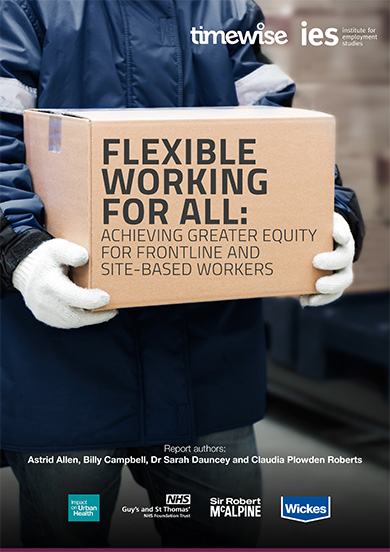
The pandemic amplified existing labour market inequalities in access to flexible working and we’re still reeling from the effects of this, especially in the context of health. While half of working adults were able to work from home at times during the pandemic, others weren’t given this option due to the location-based nature of their work.
The reality of a two-tier workforce – the ‘flexible haves and have nots’ – became starkly apparent along with the implications for worker health and wellbeing.
Emerging from the pandemic, workers given home-based options have expressed a strong interest in maintaining them. Many employers have responded to this demand by developing hybrid policies and practice, recognising its value for attraction and retention. Yet there’s been limited coordinated action to redress workplace inequalities by investing in innovation and design to organise work differently for frontline and site-based employees.
So, supported by Impact on Urban Health, Timewise joined with the Institute for Employment Studies (IES) and three trailblazing employers – Guy’s and St Thomas’ NHS Foundation Trust, Sir Robert McAlpine and Wickes – in a two-year long action research programme to introduce flexibility into frontline roles and evaluate its impact, on both the individual and the organisation. Our report outlines the findings from our journey together and shares learnings to make access to flexible working more equitable.
We tested the idea that good quality flexible work improves employee health and wellbeing, leading to benefits for employers, such as improved retention. Timewise co-designed activity with each of the three participating employers to give site-based workers greater input and control over their working patterns. Then in collaboration with IES, we considered the impact of increased flexibility on individuals from the point of view of their experience of health and wellbeing, work-life balance and job satisfaction, and on organisations from the perspective of levels of engagement, attendance and retention.
Our programme shows that flexibility is both central to how people want to work in the future and is practically possible even in ‘hard to flex’ roles. Where flexibility is introduced with the support of senior leaders, and is driven by teams at a local level, it results in positive impacts for both individuals and organisations. Workers report improvements to health and wellbeing, work-life balance, and a desire to stay longer with their employer. For employers, this means higher levels of employee engagement, lower levels of sickness absence and increased staff retention.
For the organisations involved in this programme, there’s no going back to former ways of working. They’ve embraced the changes and are moving forward with plans to scale up to ensure all are able to benefit through increased input and control over their working pattern.
Published July 2024

By Amy Butterworth, Consultancy Director
Employers are facing a mounting list of challenges, from skills and labour shortages to a tightening economy to adapting to changing workforce demographics, where 1 in 3 workers are now over the age of 50. However, not all employers recognise the importance of older workers or understand how to retain them.
Workers in their 50s and 60s are willing to continue working later, albeit flexibly and yet many employers are still reluctant to offer flexible working options. While those who embrace flexible working will maximise the benefits of multi-generational workforces and be the leading employers of the next decade – maximising the knowledge, skills and talents of all ages.
We know first-hand the importance and value of older workers because our organisations came together in 2023 to create inclusive workplaces. Timewise is a proud supporter of The Centre for Ageing Better’s (CFAB) Age-Friendly Employer Pledge, a nationwide programme for employers committed to improving work for people in their 50s and 60s, and is helping to deliver some of the training.
We’ve run three masterclasses for employers who are CFAB pledge signatories, focusing on designing flexible work, making the business case for flexible work for older workers and bringing about changes to organisational practices, behaviours and mindsets.
In the masterclasses, managers focus on their role in influencing the way older workers experience work and how flexible roles can help with organisational challenges. Employers from different sectors and sizes shared similar experiences about older workers, who tend to feel less comfortable asking for flexibility than younger colleagues but provide valuable skills and knowledge that need to be protected. They also discussed the challenges of leading teams in multi-generational workplaces and balancing the needs and demands of a diverse workforce.
Findings from CFAB’s State of Ageing Report 2023-24 showed that employment rates among older workers vastly differ between men and women, disabled and non-disabled people and different ethnic groups. We strongly believe that taking action as an age-friendly employer will confront ageism and contribute to a more equal workplace for all.
Taking small steps to proactively build inclusive workplace cultures, where managers feel empowered to support flexible working for older workers will strengthen organisations and ripple across other groups within the workforce.
Here’s our advice to help you develop an age-inclusive workplace culture…
Analyse workforce data by age to see where the biggest challenges are. Look at the age of new hires, promotions, training participants and exits. Are older applicants less likely to get interviews? Are employees in their 50s and 60s accessing training and development? Look at your employee survey scores. Does satisfaction and engagement differ with age?
Create an environment where managers feel equipped to proactively raise age-related topics in conversations and employees feel comfortable in sharing how they feel. Encouraging open conversations will help challenge stereotypes and dispel negative perceptions that might be associated with age. Stereotypes about employers and certain industries can also exist. Focus on the flexibility and value these sectors offer.
Flexibility attracts and retains workers in their 50s and 60s as it supports those who want to work. Flexible work supports older workers with caring responsibilities and managing their health – but it also can give space to get other things out of life. If a job can done flexibly, it can be done by anyone.Flexible working arrangements can make a huge difference to keeping a person in their 50s and 60s in work. Giving employees the opportunity to discuss and adjust their working patterns will go some way towards them staying in work and improve overall retention.
Line managers have direct contact with employees so it’s important to equip them with actionable support to have conversations about flexible working. Develop helpful resources, like a culture toolkit to support them with how to phrase language to use and where to go for more information. Consider how managers can help older workers feel comfortable asking for flex or aware that it’s even an option. It’s also worth thinking about the dynamics between younger line managers and older employees. In one masterclass, an employer shared that in their organisation, the wider the age gap between manager and employee, the higher likelihood of the employee leaving. Supporting and empowering line managers, who play a vital role in employee experience is vital.
Rethink hiring processes to accommodate older workers’ needs. Our research shows that making job adverts more appealing to older workers does not deter younger workers. Avoid terms like ‘recent graduate’ and add a diversity statement that includes age-inclusivity.If you offer flexible work options, include part-time options in your job descriptions as 69% of job adverts don’t. Older workers probably won’t look at jobs that don’t mention part-time or flexible work.
Don’t put age diversity on hold any longer. It has the potential to bring value to organisations, benefiting not just those in their 50s and 60s but all groups within the workforce positively. We’re seeing some employers taking steps to address this issue, but not enough. Embracing age and a multigenerational workforce can increase productivity, profitability and make employees feel happier and engaged, why wait?
Sign The Centre for Ageing Better’s Age-Friendly Employer Pledge and learn more about Timewise’s workshops and training, which can be tailored to your needs.
Published April 2024

By Amy Butterworth, Consultancy Director
As Marcus Buckingham notably said, “People leave managers, not companies.” That’s why companies that take retention seriously tend to make sure their managers have the skills they need to lead and support their teams. But it’s fair to say that recent events have created some fundamental new challenges for managers to deal with – and in many cases, the training hasn’t caught up.
Despite the move to remote working during lockdown, and the subsequent shift towards a hybrid model, research from the University of Birmingham found that only 43% of managers had received any training in how to manage hybrid teams. It’s not a stretch to say that this could be why 47% of line managers are finding work more stressful than pre-pandemic. And with many companies now struggling to find the right balance between time spent in and outside the office, having skilled-up line managers is becoming even more critical.
It’s for this reason that we joined forces with our friends at the Chartered Management Institute (CMI) to run a three-month project, Making hybrid work for you and your team, exploring what’s happening on the ground with hybrid working, and what difference intensive management training can make. And the results surprised even us.

By Claire Campbell, CEO, Timewise
Is the remote vs in-office debate still the only flex topic in town? And if that’s all anyone is focusing on, what are we missing?
There’s a new story every week about companies stopping employees from working some or any of the week from home, with Loreal and O’Rourke just two very recent examples. And yes, we agree that creating opportunities for teams to come together is hugely valuable (as long as it is planned and implemented carefully, so people aren’t just commuting in to sit on Teams calls all day).
But this unrelenting focus on getting everyone in full-time holds two potential dangers for employers. At a general level, it creates a perception that remote is the only flex worth talking about, when there are other ways to provide a better work-life balance. And, more specifically, it ignores the role that flexible working can play in tackling workplace priorities such as diversity and inclusion.
We’ve always believed that the power of flexible working to boost D & I is one of its biggest strengths, and have worked with many employers to build this into their strategies. It’s not rocket science, after all; offering a range of working patterns that take into account people’s different needs is bound to help you attract and retain different groups of people.
Numerous studies bear this out. When Zurich identified a lack of applications from women for senior roles, they launched a flexible working initiative which led to a 66% boost in applications, with one in four of the new female hires choosing to work part-time. And just this month, Wharton reported that when STEM job listings shifted to remote during the pandemic, they drew a 15% increase in female applicants, and a 33% increase in underrepresented minority applicants.
Unsurprisingly, flexible working is also important to people with additional responsibilities or needs. In a study by University of Lancaster, which focused on how remote working can support employees with a disability or long-term health condition, 70% of disabled workers said that if they were not allowed to work remotely it would negatively impact their health. ONS data has shown that, among older workers who have left the workforce since the pandemic and would consider returning, a third said that flexible working was the most important factor (higher than good pay). And a survey of mothers last year suggested that, while 98% of women want to return to work after maternity leave, only 13% think it is viable on a full-time basis.
Clearly, then, the data indicates that flexible working is a good way to attract and retain a wider range of people, including women, carers and people with health issues. So there’s a strong social argument for actively using flex to help these groups enter or re-enter the workforce.
Similarly, it’s worth noting the particular role that flexible working can play in tackling the ‘S’ in ‘ESG’. We’ve written before about the risk of two-tier workforces, in which flexible working is more readily available to people in office jobs than it is to those working in frontline roles (which are frequently lower paid). As this makes it even harder for those at the lower end of the pay scale to access work that fits with their lives, it’s likely to keep people out of the workforce, and so amplify existing inequalities. Better flexible working for all can help close this gap.
It’s equally important to remember that having a more diverse workforce has been shown to make economic sense. 2017 research by McKinsey calculated that improving diversity could add £150 billion a year to the UK economy by 2025, and companies with diverse boards have been shown to outperform their rivals. So there are sound business reasons, as well as social ones, for boosting diversity and inclusion through flexible working.
And on the subject of the business case, our Fair Flexible Futures projects showed that investing in flexible working can pay for itself within three years, due to reduced sickness absence and increased staff retention.
So, instead of going hell for leather trying to get everyone back into the office, it would be better for leaders to step back a bit. To think about whether their business and talent imperatives could be well-served by introducing flexible working – of varying kinds, to match the needs of their current and future workforce – and to invest a bit of time and resources in doing it well.
The arrival of ‘Day One Flex’ rights in April means that now is the perfect time to revisit your flexible working strategy, and embedding D & I into it makes a lot of sense. If you’re not sure where to start, or how best to take it further, we’re here to help.
Published February 2024

By Clare McNeil, Director, Timewise Innovation Unit
The explosion in flexible working as a result of the pandemic – particularly in its home and hybrid working forms – had a clear impact on the number of flexibly advertised jobs. After creeping up by a percent or two each year from our first Flexible Jobs Index in 2015, just 15% of roles were advertised with flexible options in 2019. By 2022, that number had doubled to 30%.
It’s therefore disappointing to see from this year’s Index that this rate of growth has dramatically slowed. Our research indicates that 31% of job adverts now overtly offer some form of flexible working; a negligible change from the previous year, and a big drop from the kind of increases we’ve got used to. And even the growth in the number of home and hybrid working jobs that are advertised as flexible – which went up 9% between 2019 and 2022 – has stalled.
So does this mean that we’ve hit a peak in the proportion of jobs that are advertised as flexible? Is this it? We’re clear that it mustn’t be.
The fact is, the need and demand for flexible working are as strong as ever. Although the vacancy peak of 2022 is slowing, economic growth continues to be held back by a tight labour market, and in many sectors, including healthcare, education and hospitality, staff shortages are at critical levels. Given that 9 in 10 people want to work flexibly, and 4 million UK employees have changed careers due to a lack of flexibility at work, it seems hugely short-sighted that employers are failing to use flexible working to attract new staff.
It’s not just about getting employees in, either; flexible working has a huge part to play in creating strong, healthy workplaces in which people stay, and thrive. It’s been shown to improve health and wellbeing, increase inclusion for key groups (including parents, carers and people with health issues), reduce absenteeism and even boost productivity. What’s more, our research has indicated that the changes required to offer flexible working can pay for themselves in just a few years, through reduced sickness absence and improved staff retention.
All of which makes it surprising that more companies aren’t including flexible working in their talent toolkits. And with new legislation due to be introduced in spring 2024, which gives people the right to request flexible working from day one in a new job, it really is time for employers to get off the fence and start proactively offering it to new employees at the point of hire.
So how can we get back to a position where the number of flexibly advertised jobs is increasing at a more promising rate? Our Flexible Jobs Index sets out a number of actions that employers and policymakers can take, including:
These changes, and the others recommended in our report, could reboot the growth in flexibly advertised jobs, and get us back on the path towards a flourishing economy, powered by a healthier, more equal workforce. Let’s not lose the momentum that we gained during and after the pandemic; we need to keep moving forwards, and we need to start now.
Published November 2023

By Amy Butterworth, Consultancy Director
It’s no secret that frontline and shift-based jobs are harder to make flexible than office-based ones. From the obvious barriers around working from home to the requirement to have a balance of skills on a shift or site, there’s just less room to manoeuvre when a frontline employee needs flexibility.
Here at Timewise, we see this as a challenge, not a barrier; we’re working with employers across the frontline, including NHS trusts, construction companies, schools and retailers, to level the flexible playing field.
But although the dial is starting to shift on access to formal flexible arrangements, most frontline staff are still missing out on something else that many office-based workers take for granted – ad-hoc flexibility.
Sometimes, life happens in a way that requires flex at short notice; an hour here, or a morning there, in a way that can’t be planned in. It might be a child’s school assembly, or an elderly relative’s doctor’s appointment; it might be something as seemingly trivial as a tiny window in which to book tickets for a favourite band’s farewell tour.
Faced with these scenarios, most office-based workers would simply come in late, or take a bit of time out, and make it up later; but for a frontline employee, that’s not an option. Rosters are often created months in advance, and while colleagues might be willing to swap shifts or cover for each other, it’s not a given – and puts the onus on the employee to call in a favour. So as well as exploring more formal flexible arrangements, proactive employers are also looking at ways to give their frontline and shift-based staff access to this more informal, ad-hoc flexibility.


