Our year-long pilot into improving work-life balance has delivered three key recommendations to support the attraction and retention of nurses.

Nursing has been highlighted as ‘the most urgent challenge’ in the Interim NHS People Plan. Our year-long pilot has focused on improving nurses’ work-life balance by addressing their working patterns. And it’s delivered three key recommendations to tackle the nursing shortage head-on.
It’s well-known that the NHS is struggling to find and keep enough staff, but the numbers relating to nursing shortages are no less shocking for their familiarity. Nurse resignations for poor work-life balance have increased by a staggering 169% between 2011-12 and 2017-18, according to analysis for the Labour party. And the Interim NHS People Plan notes that the organisation will need to recruit 40,000 extra nurses in the next five years just to stand still.
As we know from our work in other sectors, offering flexible working is a sure-fire way to improve work-life balance. But in a shift-based, skills-driven, 24-hour environment like an NHS ward, it’s complex to introduce. As a result, most wards operate on a two-tier system in which a few, fortunate individuals have an agreed flexible working arrangement (FWA), usually for childcare reasons. Everyone else then has to fit around them, with minimal input and even less predictability.
Over the last year, we have been supported by the Burdett Trust for Nursing to explore potential solutions for making work-life balance available for all, and not just those with a FWA.
Our belief was that by increasing the fit between nurses’ working pattern preferences and their actual working patterns, more of them would stay. At the same time, we were mindful that any solution would need to work within the KPIs and mix of skills that ward managers needed to deliver.
So, building on academic research, and following a series of focus groups with participating hospitals, we piloted a team-based approach to rostering , with the aim of increasing the amount of input that nurses have into their working patterns, whilst taking into account the operational constraints of life on the ward.
A sizeable piece of action research, this two-stage project involved 240 nurses in seven wards across three NHS trusts. We ran the first, six-month stage at Birmingham Women and Children’s Hospital (BWCH), and used our findings to inform the second stage at Nottingham University Hospitals (NUH) and University Hospital Southampton (UHS).
We began at BWCH by creating and training a lead team for each ward who were responsible for creating the roster (previously undertaken by the ward manager). Each lead team were allocated a subgroup of nurses and tasked with finding out their long-term preferences.
The lead team members then worked together to create the roster based on their colleagues’ input, making sure that unpopular shifts were spread fairly and that each shift had the right number of nurses with particular skills.
Following the completion of the first pilot at BWCH, we fed our learnings into the second six-month stage, across all three hospitals, and finished with a formal evaluation.
Our evaluation indicated that there were three main benefits to team-based rostering. A comparison of pre- and post-pilot data showed:
Other important findings include: the critical role played by the ward manager in making the new approach work; the need to choose the lead team members carefully, to ensure the right balance of skills; and the extra time (and so budget) required to train the teams and deliver the roster.
Overall, then, we are cautiously positive about the potential of team-based rostering; indeed, the teams who worked with us are continuing to create their rosters in this way. However, there’s no question that more work is needed so that other teams and NHS Trusts can benefit from what we have learned. And, given that most of the guidelines on flexible working in the NHS are not adapted for shift-based roles, it’s also clear that bespoke definitions need to be developed.
We are therefore making the following recommendations to bring about widespread change:
It won’t be a quick fix; these kind of changes take time, money and serious collaboration. But by taking action, we stand to gain a happier, healthier workforce who will stay within the NHS for longer. And given that nursing shortages are already at critical levels, there’s no time to waste.
Published September 2019
By Emma Stewart, Co-Founder, Timewise

First, the good news. This year’s Flexible Jobs Index, our annual report tracking the proportion of flexibly advertised jobs, puts the 2019 figure at 15%. In 2015, it was 9.5%, so the trend is continuing in the right direction.
But, but, but… it’s painfully slow, inching up by a couple of percentage points (or less) each year. If it continues at this rate, it will be a long time until the supply of part-time and flexible jobs matches the demand (which our research puts at 87%).
And when we dug deeper into the data, we uncovered some insights that employers who want to get the best from their workforce shouldn’t ignore:
While the highest salary bracket (jobs paying £80K FTE) has the fastest rate of growth, these roles are more likely to be described as ‘flexible’, rather than ‘part-time’. This may make it harder for key groups of employees to progress, particularly women who can’t work a full week. And that, in turn, can have a knock on effect on issues such as the gender pay gap.
There’s still a sharp drop in the availability of flexibly advertised jobs between the under £20K band (23%) and the £20K – £34K band (14%). This creates a structural cap on progression for many low-paid workers who have skills, but need to work flexibly. And it is certainly likely to make it harder for employers to build an inclusive, motivated workforce.
Finally, there are big discrepancies between the availability and growth of flexible opportunities in different sectors. In health and social services, for example, the percentage of flexibly advertised jobs far outstrips those of sectors such as construction and engineering. So it’s critical to have a sector-specific focus for any flexible working strategies you develop.
The chances are that at least one, if not all, of these insights are relevant to your organisation. So ignoring the data isn’t an option, particularly in an era of skills shortages and market uncertainty.
What’s more, offering flexibility up front may soon become a legal obligation. As I’m sure you’re aware, the government is consulting on proposals to support families, one of which is to give employers a duty to consider advertising all jobs as flexible.
So it would be well worth employers getting ahead of any potential reporting requirements, by taking steps to address the issues thrown up by this year’s Flexible Jobs Index sooner rather than later. In our view, they can’t afford not to.
Our consultancy and training team offer a range of services to help employers design, develop and deliver a flexible working strategy within a supportive culture. Please get in touch to find out more.
Published October 2019

By Cathy Halstead, Editor, Timewise
Here at Timewise, we are keen to share our flexible working expertise as widely as possible. But as we all know, the peer to peer viewpoint is also a highly useful resource. So we asked Justine Campbell, EY’s Managing Partner for Talent, UK and Ireland – responsible for attracting and retaining talent – to share what the firm has learned, and how it has benefitted, from the journey to a fully flexible culture. Here are her insights.
As our recent Power 50 awards highlighted, flexible working is no longer about people juggling caring responsibilities. People of all ages, from all sorts of backgrounds, are choosing to work flexibly for a wide range of reasons. The result, Justine believes, is that flexible working is no longer a nice to have; it’s becoming an expectation from prospective employees.
“In a 24/7 global culture, backed up by supportive technology, flexibility is becoming the norm. So any employer that wants to be truly competitive needs to have flexible working as standard. It’s a business imperative.”
It seems obvious, then, that making flexible working available to potential candidates should be part of a future-focused firm’s recruitment strategy. But being willing isn’t enough, says Justine.
“If you want to attract the best talent, you need to be prepared to shout about your approach to flexible working, not wait to be asked. And given the number of hires we make each year – over 2,000 experienced candidates in 2018 – this is something we take seriously.
“We state clearly that our roles are open to flexibility, and empower and challenge our hiring teams and line managers to deliver on this. For us, the key question is not ‘Can we make it work’ but ‘How can we make it work?’”
Similarly, flexible working has a big impact on retention; by offering people what they want, you’re more likely to keep hold of them for longer. And it doesn’t end there, according to Justine.
“We often say that you can’t put a price on flexible working. Speaking personally, I wouldn’t trade my flexibility for a salary hike; it’s worth too much to me. But at a firm-wide level, being able to hang on to talented employees is about more than just retention rates.
“For example, Michael Heap, who was a 2019 Timewise Power Climber, now works for us three days a week, to free up time to develop his own tech business (Tmup). This is teaching him new skills and developing his entrepreneurial abilities. EY and our clients will benefit from that as much as we do from his day-to-day experience.
Proactively offering flexible working to potential and current employees is also likely to lead to a more diverse workforce. And that has been shown to have a positive impact on the business as a whole, as Justine notes.
“It’s easy for businesses that don’t have diversity of experience to get stuck in their ways. In our world, we need a degree of professional scepticism, which we wouldn’t get if we only had identikit employees. Successful workplaces reflect the outside world, whether that’s in terms of gender, age or ethnicity, and flexible working has a key role to play in making that happen.
Clearly, formally defined arrangements such as part-time or annualised contracts need formal contracts. But Justine has found that incorporating informal flexibility into EY’s culture is also part of the solution.
“We think of it in terms of outputs – that is, what needs to be delivered by when – rather than focusing on how long people are sitting at their desks. So if one of my team wants to go for a run before starting work, or drive home before making a call to avoid the rush hour, that’s fine by me.
“As long as you trust your employees (and if you don’t, perhaps you should question why you employ them), you should be happy for them to work in the way that suits them best. In my experience, it makes people more productive, as well as having a positive effect on their wellbeing and loyalty.”
However, to make all these elements work together, there’s one factor that can’t be overlooked: the role played by an organisation’s leadership. As Justine explains:
“There are so many factors involved in making flexible working a success, from investing in technology and job design to championing role models and training line managers. It’s not just an add-on or a written policy; you have to embed flexible working into your company culture. And that’s not going to happen unless it comes from the top.
“We have members of our leadership team working part-time or flexing their hours in a variety of ways, and they’re very open about it. That kind of visibility is worth a huge amount; our leaders are not only setting our flexible strategy, they’re also showing by example that it can be done.”
As EY’s experience shows, a lot of work goes into creating a successful flexible working strategy. And, as Justine and the team at EY have found, it’s well worth getting expert support.
“We’ve been collaborating with Timewise on our flexible hiring strategy since we started on this journey and their support has been invaluable. They have set the standard for flexible working and will ensure you make a success of it.
“The fact is, if you want to be competitive in the future, you need to be flexible. The future of work starts now; get some support, make a start and make it happen.”
Now that flexible working has become more mainstream, we’re more likely to be found advising clients about how to make it happen than why they should do so. But it doesn’t hurt to have a reminder of how being flexible can benefit your business.
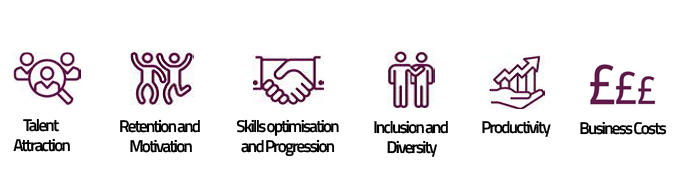
From finding and keeping the best people to cutting overheads, here are the reasons why forward-looking businesses are making flexible working a priority.
If you want to get your hands on the very best people in your industry, you need to take flexible working seriously. 87% of full-time workers either work flexibly already, or wish they could. The numbers are similar for men (84%) and women (91%). And amongst people who are not currently working, 93% want a job that includes some sort of flexibility.
But according to the 2023 Flexible Jobs Index, just 3 in 10 jobs are advertised with flexible working options. This huge gap between supply and demand means that offering flexibility gives you a bigger pool of candidates to choose from. It will also give you the edge over your less flexible rivals.
Once you’ve got the best people in, and spent time and money training them, it makes sense to try and keep them. And whereas financial incentives only tend to buy short term loyalty, real flexibility is harder to come by – and so more likely to encourage people to stay.
A survey by the CIPD1 backs this theory up, with 75% of employers saying that flexible working has a positive effect on retention and 73% saying it improves staff motivation. So, if you want to hang on to your star employees, offering them flexibility is a great place to start.
True flexibility isn’t a one-off negotiating tool. If you build it into every level of your organisation, you won’t just encourage your staff to stay; you’ll allow them to progress too.
By making flexible working available within senior and board roles, you’ll provide your flexible employees with a clear career pathway. This will allow your organisation to make the most of their skills and experience, rather than leaving them stuck in roles that don’t make the best of their abilities.
You’re also likely to increase the proportion of women at a senior level, which is known to bring a wider perspective into decision making, and to help close the gender pay gap.
The role that flexible working plays in improving female representation at senior level is also important from an inclusion perspective.
According to a report by McKinsey, gender-diverse companies are 15% more likely to achieve financial returns above their industry average. Given that most companies now have a formal inclusion and diversity policy, flexibility is a useful tool in improving your gender balance.
Flexible working can also support the inclusion of older workers, by allowing them to work for longer and ease into retirement. And it can help people with disabilities or mental health issues stay in work, by making it easier to balance their job with the need to take care of their well-being and attend medical appointments.
It’s often assumed that flexible workers are less engaged and less productive than their full-time peers. In fact, the opposite is true.
A survey by BT in 2014 found that the productivity of flexible workers increased by 30%. And in a study of flexible workers undertaken by Cranfield University2, 97% of managers said the quantity of work improved or stayed the same and 93% said the quality of the work improved or stayed the same.
Finally, although it’s an obvious point, it’s worth repeating: by allowing your employees to work remotely, you’re likely to have less people in the building at once.
This can allow you to reduce both your office space and your carbon footprint, and cut your business overheads significantly. For example, BT have stated that reducing their physical office space through flexibility has yielded global savings of £100 million a year.
But you don’t have to take our word for all this. Businesses agree, too: the 2015 CBI Employment Trends Report states that almost all businesses (94%) believe flexibility is vital or important to the competitiveness of the UK’s labour market and for prospects for investment and job creation. If you’re convinced of the why, and ready to start exploring the how, we’re here to help.
Updated January 2022
1 “Flexible Working Provision and Uptake”, CIPD
2 Cranfield University/Working Families 2008: “Flexible Working and Performance”

It’s increasingly understood that employers who take proper care of their employees don’t just get a warm feeling inside. The impact of positive well-being and engagement, on the individual and their performance, is no longer in any doubt. And flexible working has a huge part to play in making this happen.
To start with, it has been shown to support general mental and physical well-being, in a number of ways:
And here are some more specific examples of the positive impact it can have on employees:
For parents of small children, and people looking after an elderly relative, being able to flex around medical appointments, school runs and other logistical issues makes being a carer easier to manage.
When senior level flexible roles are made available, people who need to work flexibly are able to progress their careers, making best use of their skills and improving their job satisfaction.
In a Cranfield University[1] survey of flexible workers, 97% of managers said their quantity of work improved or stayed the same and 93% said their quality of the work improved or stayed the same. Achieving more within a flexible framework is likely to lead to increased job satisfaction.
All of the above make it more likely that flexible workers will be more motivated and happier. According to Dr Mark Winwood, a clinical director of psychological services, “The more control any of us feel we have over our working lives, the better we feel about work.”
It’s for all of these reasons that the demand for flexibility is at an all-time high. Our own research has indicated that 87% of employees either work flexibly already, or wish they could. And according to a survey by the Centre for the Modern Family, 23% of UK workers would be willing to take a pay cut in order to have more flexible working hours.
So if you want to recruit and retain healthy, motivated and productive employees, focusing on flexibility is a great way to start.
Published December 2018

Our enduring social aim at Timewise is to enable women and men to find the flexibility they need in their careers without reducing their value in the workplace.
Professional services firm Deloitte also shares this aim – providing a working environment where everyone is able to enjoy a successful career alongside a fulfilling life outside work. It is this shared aim that led Timewise and Deloitte to produce our Manifesto for Change.
To prepare our manifesto, a research survey was conducted amongst 1800 professionals working in the UK. The survey was followed up by qualitative research interviews with 12 business leaders.
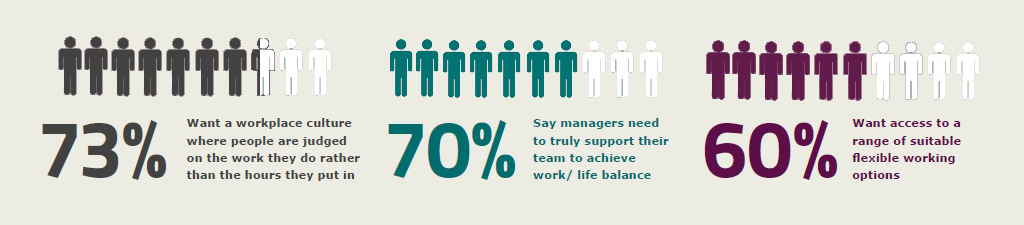
Key findings from the research are shown below:
The survey identified several perceived barriers to flexible working, including outdated workplace cultures and attitudes that perpetuate the ‘flexibility stigma’. It’s clear that even when business leaders want to accommodate the flexible working needs of their employees, there is a gap between what is said at the top and how that translates to everyday working life.

Because the barriers to embedding flexible working are primarily cultural, success must go beyond a programmatic approach. Both the survey respondents and our interviewees told us that real change only comes when leaders challenge workplace culture and dismantle practices that are no longer fit for purpose.
Based on the survey results, we developed a Manifesto for Change. We want this to be a blueprint for attitudes and actions across UK organisations. We want business leaders to recognise that getting flexible working right will drive success in their business. We want them to share best practice and be brave in trying new approaches.
The following five manifesto actions are what we believe will accelerate workplace change, making it fit for today’s flexible workforce:
Published May 2018

Flexible working means different things to different people. Our research focuses on the following types of flexibility, which are generally seen as favourable for the employee:
Our respondents included full-time workers who might be working flexibly now (or not), and may have told us they would prefer to work part-time or to work full-time but with flexibility in their working pattern.
BUSINESS IMPERATIVE TO HAVE A PROACTIVE STRATEGY FOR FLEXIBLE WORKING
THE NEED TO OFFER FLEXIBLE WORKING IN THE RECRUITMENT PROCESS
Timewise commissioned the survey from ComRes, who interviewed 3,001 UK adults online between 13th and 26th June 2017. Within these sub-samples: 1,250 full-time employees; 750 part-time employees; 500 self-employed people; 501 people who were not working but wanted to work. All participants were aged 18+. The data for full-time employees and for part time employees was weighted to be representative of the UK working population for those employment types; other data were unweighted.
Published September 2017
By Karen Mattison MBE, Co-Founder
 Here at Timewise, we are known for our robust research into the headline issues around part-time and flexible working. Our findings around who wants to flex, and the impact of doing so on pay and progression, are widely quoted and are helping to drive mindset and culture change all over the UK.
So when we heard anecdotal evidence that part-time employees feel they are missing out on opportunities because they aren’t treated as full members of the team, we considered that this too was worth investigating. While it may sound like a softer issue, we suspected that it could have a serious impact, not just on part-timers’ wellbeing, but also their ability to deliver their roles successfully, and therefore on business performance.
The resulting research, and subsequent report, Part-Time Work: The Exclusion Zone? shows that we were right to be concerned. Amongst the headline findings are that two-thirds of part-timers feel isolated at work and struggle to make connections, and a similar number feel less up-to-date with team developments. More than half also feel they have fallen behind their full-time colleagues in terms of skills and knowledge.
And while that’s not great for the employees themselves, it also has implications for employers, who are failing to capitalise on the talent and potential that their part-time workers have to offer. Which, as we know only too well, can create extra challenges around issues such as board diversity and the gender pay gap.
The good news is that this workplace ‘flexism’ can be tackled relatively easily. Simply by taking part-time schedules into account when planning team meetings, client events and social opportunities, employers stand to maximise the impact that these employers can have on the business.
They’ll also be better placed to upskill and progress their part-time workers by considering them more carefully when planning training and other development opportunities. And inevitably, that will allow them to hold onto these talented employees for longer.
We’re responding to this research ourselves, by launching the Timewise PowerFlex Network, the UK’s first-ever cross-business network to support middle and senior management part-time and flexible workers.
Designed to offer a dynamic mix of networking opportunities, inspirational speakers and bespoke training, it will be scheduled to help part-time and flexible workers enjoy the kind of opportunities that their full-time colleagues take for granted. If you’d be interested in hosting an event, or would like to know more, do please get in touch.
Part-time workers don’t expect the world to revolve around them. As their responses made clear, they fully accept that they can’t be present for every single meeting or event, and that there are times when they will need to be flexible in return.
But given that 9 in 10 employees say they would prefer to work part-time or flexibly, there’s no room for flexism in today’s workplace. This issue needs to be addressed if employers are to reap the rewards of an increasingly flexible workforce; if you need any support, we’ll be happy to help.
Published December 2018

By Emma Stewart, Co-Founder
In October last year, as part of the discussion around the gender pay gap, the Prime Minister called on employers to make flexible working a reality for all employees. Her proposal, which we have long been lobbying for, is that companies should advertise jobs as flexible from day one, unless there are solid business reasons not to.
Following this call, the Department for Business, Energy and Industrial Strategy (DBEIS) has established a new Flexible Working Taskforce, chaired by the CIPD. It brings together representatives from government, employee groups, employer organisations and other professional bodies, and I am delighted to have been asked to join it.
Over the next 18 months, the taskforce will be investigating the barriers that prevent employers from offering, and individuals from taking up, flexible working options. It will also identify positive actions to overcome these barriers. This is a fantastic opportunity to drive real change, with government input and investment behind us.
I have already presented an insight session on flexible hiring to my fellow taskforce members, in collaboration with Lloyds Banking Group, sharing what works and how it works. And I am looking forward to incorporating the Timewise perspective further, as we review the employee life course from recruitment to retention to progression. Our aim is to develop tangible recommendations that will encourage and support more businesses to embrace both flexible working and flexible hiring.
It’s an exciting time for those of us in the flexible working sphere. As I’m sure you’d expect from Timewise, we’re grabbing the opportunity and making it count. We’ll let you know any developments as they arise.
Published July 2018
By Karen Mattison, Co-Founder
The recent coverage of the gender pay gap has shone a much-needed light on the scale of the problem around female workplace progression. And it’s encouraging to see so many companies promising to take action, from training HR managers in unconscious bias to introducing mentoring programmes that boost female employees’ confidence.
But although initiatives like these have a part to play in helping women to progress, they don’t actually address the root of the problem, which is this: today’s workplace is not set up for families in which both partners work. The systems we have in place are still, even in 2018, based on senior people being able to put their jobs above everything else.
To give you an example, I was talking to a colleague recently about a networking event. The topic was interesting and relevant; the attendees were people she would have loved to connect with. But there was one sticking point: it was in the evening.
Now, if she really wanted to go, she could have found a way to make it happen. If her partner wasn’t able to get home in time, she could have tried to extend her childcare, or get a babysitter. But not all women, or indeed all parents, can jump through these hoops; and certainly not every time.
The fact is that this workplace norm, like so many others, is structurally incompatible with family life. And until we start dismantling these norms, and replacing them with flexible-friendly ones, female progression, and gender parity, will remain elusive.
It’s for this, critical reason that we have been working with Deloitte to create a Manifesto for Change. Built on our findings from a large-scale study and in-depth interviews with 12 business leaders, it’s a practical plan for action, setting out five steps that UK businesses need to take if they are to reset their workplaces:
The study particularly highlighted the degree to which the status quo is not supportive of flexible progression. 30% of respondents said they felt flexible workers were regarded as having less status and importance, and 25% felt such workers were given access to fewer opportunities and missed out on potential progression and promotion opportunities. It also made it clear that the onus is on employers to take down the barriers to flexible working, through cultural and structural change.
So now, employers, it’s over to you. Our research has flagged up the issues and our manifesto has set out the steps that will help you overcome them. And with the countdown to the next round of gender pay gap reporting having already begun, it’s time to take action. If you need help getting started, please get in touch.
To find out more about our training and consultancy services, including our introductory Flexible Audit, please call 020 7633 4444 or email info@timewise.co.uk
Published May 2018