There are many reasons why older workers are leaving the workforce; the good news is, flexible working can help address them.
By Nicola Smith, Director of Development and Innovation

There’s been much discussion in recent months about increasing numbers of older workers leaving the workplace. The ONS figures back this up, showing that over 200,000 people aged 50-65 have left the jobs market over the last two years. Commentators, including the Resolution Foundation and the Institute for Employment Studies, have also concluded that post-pandemic shifts in labour supply have largely been driven by falling numbers of people aged 50 and over looking for and available to work.
So it follows that a key way to fill the high number of vacant roles would be to encourage and support older workers to stay in their roles, or come back into the workforce. And the good news is, flexible working can help make this happen.
It’s worth noting that ‘over 50s’ is a very wide category. As a result the health status, caring responsibilities, skills and incomes are probably more varied within this group than those of people in any other commonly used age bracket.
And while it’s relatively well understood that flexible working can support those with ill health and disabilities to remain in or return to the workplace, that’s not the only factor. There are other reasons why members of this group are leaving employment – and for which flexible working can also be part of the solution.
Recent ONS analysis gives some particularly useful insight into the varied experiences of older workers who have left the jobs market since the pandemic begun. Findings include:
Crucially, the figures also show that, among those who would consider returning to work, a third said the most important factor was flexible hours. Good pay came second (at 23%), followed by being able to work from home (12%) and work that fits around caring responsibilities (10%), both of which are linked to flexibility.
Clearly, then, offering flexible working is a critical part of the answer to employers’ retention and hiring woes. By helping to overcome the medical, personal or financial reasons why older workers are leaving the workplace, it could encourage them to stay for longer, or encourage those who have already left to come back.
Our work with the Centre for Ageing Better set out how and why employers can use good flexible working to boost the retention of older workers. And when it comes to supporting them back in, the answer is clear: employers need to advertise flexible roles from the point of hire. In both cases, this means going through a job design process that explores when, where and in how much time the role can best be fulfilled.
Today’s data make an even more compelling case for why everyone needs to act – and is a pertinent reminder of the benefits that more, good flexible working at the point of hire could bring for business and workers alike. We know that many employers are already doing this well, and that many others recognise that they need to make the shift; if you need support with this, we’re here to help.
In the meantime, keep an eye out for our new Flexible Jobs Index, launching later this month, which will highlight how far we still have to go in terms of making flexible jobs available from day one. It will be published alongside a new study, undertaken in partnership with the IES and supported by the Joseph Rowntree Foundation, which explores the challenges employers face and the actions needed to widen access to good flexible roles.
Published November 2022

Employee well-being is a workplace issue that desperately needs tackling. In the UK, a huge number of working days are lost to ill health (32.5 million in 2019/20) and stress, depression and anxiety (18 million). We know that flexible working can support employee well-being – but we also know there isn’t a one size fits all solution.
While the pandemic helped focus leaders’ attention on their employees’ well-being, and normalised the concept of working from home, it also had some negative effects, as people struggled to keep their home and working lives separate. And critically, the changes driven by the pandemic have happened in a reactive way, rather than a proactive one.
Additionally, we are now in a new, also difficult era, dominated by the cost of living crisis. Right now, financial issues are affecting the well-being of many employees, and employers are increasingly willing to think creatively about how they can offer support.
The result is a ‘golden window’ in which businesses are considering the health and well-being of their staff more than ever before. So we invited three business leaders to join us to discuss this at our recent roundtable: Richard Martin, Executive Officer of the Mindful Business Charter; Rebecca Ormond, Inclusive Workplace Leader at PWC; and Jordan Cummins, the CBI’s first Director of Health.
So, what should employers do to boost employees’ well-being in the current climate? Here are the key themes that came out of our roundtable discussion.
Review pandemic-driven decisions – and make changes where needed
The new, more flexible ways of working that evolved during the pandemic were often brought in at speed. And while they have been positive in many ways, they can also be a barrier to well-being.
For example, the removal of the boundaries between work and home has led to an expectation of being always on. And while some employees relish skipping the commute and getting more time to spend with family, there are others who feel burnt out by work creep, and miss the connections that being fully office-based brought.
Similarly, while hybrid working is seen by many as the best of both worlds, it is not without its problems. There is a risk of two track workforces developing, in which those who continue to work from home are sidelined, affecting their well-being as well as their careers. Research from the CMI indicate it’s already happening, with 40% of managers saying they have observed opinions or behaviours suggesting inequality between those who work in a hybrid way and those who don’t.
Employers should therefore take a proactive look at how decisions made during the pandemic are affecting employee well-being – and make changes where needed. This includes supporting employees to reinstate the boundaries between home and work, and taking action to ensure that the flexibility on offer is fair and inclusive. The result will be truly flexible working arrangements that benefit both the business and the employee.
Increase your understanding of your employees’ circumstances and needs
A key part of this review – and of creating sustainable well-being strategies going forwards – will be to understand what issues people are dealing with and how the business can help.
Gathering data on well-being can be hard, but people are increasingly willing to disclose details about their circumstances – and will be even more so if they understand that this may lead to greater flexibility. Set out a framework of information you think would be useful to gather, and pulse check regularly.
Shift your approach to well-being and become a prevention workplace
The positioning of well-being within an organisation is central to its success. One positive step to take is to stop treating health and well-being as a cost, and instead consider it as an asset to be invested in, like sustainability.
This will lead to well-being being seen as a competitive advantage, rather than a burden, and help you focus on preventing poor well-being, rather than reacting to it. Ideas for supporting this include:
And of course, proactively offering well-designed flexible roles, which allow employees to better balance their work and home lives, is central to being a prevention workplace.
Encourage a culture of openness and trust between line managers and teams
Building on the above, line managers should be encouraged to have open conversations about well-being with their team members. It’s a big leap for many managers to go from talking about workload to talking about well-being, but it becomes easier once a culture is established in which these conversations are not only acceptable, but preferable. Things to think about:
It’s worth remembering that most employees want to achieve and do their best at work; the business simply needs to trust and support them to do so. And that includes exploring which kinds of flexibility will make that possible.
Explore the impact of the way your organisation works
As well as putting initiatives in place to support well-being, it is also important to look at your structures and processes; in reality, it’s often the way people work that creates stress. This includes the nature of the work itself and organisational expectations, as well as how individuals interact.
A key part of resolving this is to develop a company-wide conversation about how your team members are working with each other. Then act on it in your structures and processes. For example:
Again, little things can make a big difference; thinking about when you schedule meetings, or even send emails, can reduce stress and underpin your commitment to flexible working.
Address the impact of the economic crisis clearly and swiftly
Whilst employers are not responsible for the cost of living crisis, they do have a duty to support their employees to navigate it as best they can. And being clear in communications is absolutely critical. Observations from our panel included:
Of course, this kind of support doesn’t have to be limited to a financial crisis; some companies are already looking at how they can support their employees’ financial wellbeing. Initiatives include offering pension planning to parents and carers who have taken career breaks, or providing a financial well-being expert who can explain what benefits are available and how to access them.
It’s also worth noting that part-time opportunities can support financial well-being. Offering high-level part-time jobs within your organisation could help parents, carers and others who can’t work full-time to progress their careers and increase their incomes. And doing the same when recruiting could open doors to help others back into the workplace (as well as widening your talent pool).
With learnings from the pandemic ripe for analysis, and the cost of living crisis likely to continue, it feels like the right time for employers to develop and embed their commitment to employee well-being. For the best chance of success, flexible working should be at the heart of any approach; if you need support with this, please do get in touch.
Published October 2022
By Amy Butterworth, Consultancy Director, Timewise
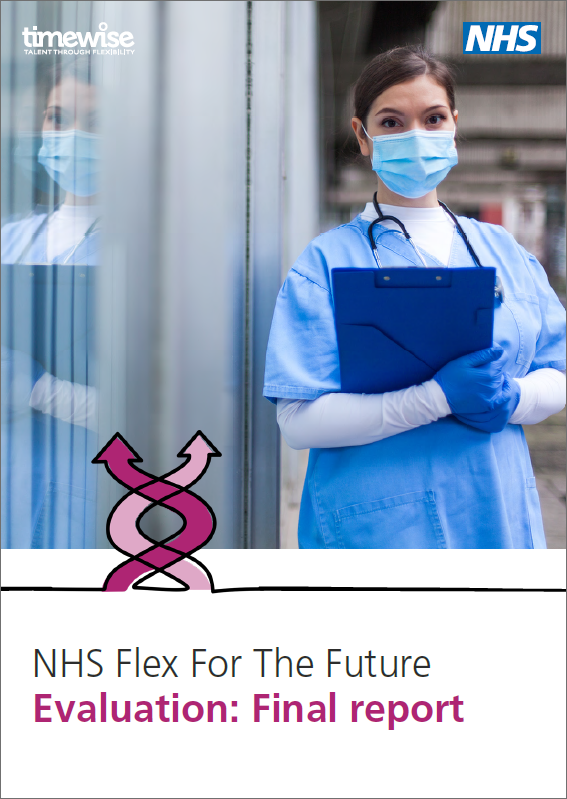
“We cannot afford to lose any more of our people.” As these words taken from the NHS People Plan make clear, the workforce crisis in our health service is now at an acute level. Recruitment and retention are more challenging than ever; data from earlier this year suggested that one in 10 nursing positions, and one in 17 doctors’ jobs, were unfilled. And in the last quarter of 2021, at least 400 NHS staff in England left their posts every single week due to inadequate work-life balance.
Faced with a mountain to climb, and believing that flexible working is a key part of the solution, NHS England and Improvement sought our help. They commissioned us to create a model for introducing and embedding flexible working practices, and to implement it at scale. The result was NHS Flex For The Future, the largest ever flexible working change project within the NHS, involving teams from 93 NHS trusts and organisations.
So what did we do? Well, as we know from our previous work within the NHS and elsewhere, there really is no one-size-fits all solution for an organisation of this size. We therefore began by tasking each trust to create their own change team, a group of at least five members of staff who knew what their specific challenges, barriers and issues around implementing flexible working would be.
We encouraged them to make sure that the change teams were representative of their trusts, and included frontline staff (such as nurses or midwives) as well as HR and OD professionals. This was critical, not only because they had first-person insights into how things work in practice, but also to ensure that any solutions were seen to be delivered from the ground up, not imposed from the top. We also asked each team to nominate an executive-level Senior Responsible Officer, who could fast-track any issues and decisions to the board, and hold senior colleagues accountable for supporting the programme and its outcomes.
Once the change teams were established, we worked to educate and upskill them through a six-month programme of workshops and advice. This included access to specialist speakers, real-time examples of innovative practice and case studies, as well as practical tools and templates to support the process. We also set up smaller, regionally based group clinics, where they could share ideas, challenges and progress with their local peers, supported by flexible working experts from Timewise and NHS England and Improvement.
Because of its scale, the programme also provided a valuable opportunity to gather information and insights that participants and the wider NHS could learn from. For example, we discovered a real disparity in data gathering around different flexible working patterns, which has a serious knock-on effect on reporting and planning within some trusts. Similarly, we discovered that while some trusts were advertising 100% of their jobs as flexible, others weren’t advertising any in this way. Towards the end of the programme, the change teams began to put what they had learned into practice by developing a business case with which to engage their leadership teams, and a tailored action plan that proposed the right solutions for their particular trust.
Of course, driving change within such large organisations is a marathon, not a sprint, and NHS Flex for the Future was very much the start of the process. Nevertheless, we are already seeing real shifts in attitude and approach from our 93 participant trusts and organisations.
70% of participants told us they have developed an action plan which was supported by their leadership teams. And as one participant put it: “The programme has helped me influence the board and not just start the conversation, but get an organisational objective on our 22/23 business plan.” There were also clear examples within our post-programme survey of how participants’ confidence and understanding has increased. When asked to respond to the statement, “I am clear as to the ways to increase the number of quality flexible roles in my NHS organisation” agreement increased to 69% (compared to 20% at the beginning of the programme). And for the statement “I understand how to design jobs with greater flexibility”, agreement increased from 30% to 74%.
We’ve also collated more detailed feedback about the impact of the programme through a set of case studies, which have really highlighted the positive impact of our work. To pick just one example, here are some insights from Fran Wilson, Lead Nurse for Attraction, Recruitment & Retention at Gloucestershire Hospitals NHS Foundation Trust:
I was already convinced that flexible working is an area that will increase staff attraction and retention, but now I have participated in the programme I have the insight, knowledge and resources to share with other people, which really helps.
We would never have got to present at trust board level without the programme, so it’s really helped raise the profile of flexible working… It’s also inspired us to start conversations from a point of yes, and how, rather than no!
It’s a big cultural change, so it isn’t going to happen overnight… but the progress we’re making is exciting… It’s been a great investment.
You can read Fran’s full case study here.
So, having educated and upskilled change teams from 93 NHS trusts and organisations, what’s next? The teams are continuing to develop and embed their action plans, and we are supporting some of them along this next stage of the journey. We’re also keen to help keep up the connections that were formed between teams from different NHS organisations, and will be looking to create more opportunities to convene organisations who are doing exciting things in this area – watch this space. In the meantime, having created and implemented this new model for change at scale, we’re eager to put it to good use, within the healthcare sector and elsewhere. If you are interested in starting a conversation with us about whether our change team model could work in your sector, please get in touch.
Published October 2022

It seems pretty clear that hybrid is the new normal. A June 2022 survey from the CIPD noted that 78% of organisations now offer hybrid working, in a mix of formal and informal arrangements. And spring 2022 ONS data showed that 84% of employees who worked from home during the pandemic plan to continue working in a hybrid way.
Here at Timewise, we see the increase in hybrid working as a hugely positive thing. We, like many organisations, believe that it offers huge benefits for employers and employees alike (as long as it is properly implemented, of course).
But an unexpected side-effect of hybrid’s increasing popularity is that it’s becoming conflated with flexible working in general. In the media, in conversations, in focus groups, people are using the phrase flexible working when what they mean is hybrid working.
To give just one example of many, in a recent discussion we held with a group of frontline workers, a participant stated that “Flexible working won’t work for us – we can’t do our job from home”.
So, what’s the problem here? Well, firstly, it’s just not accurate to conflate the two. Hybrid working is essentially place-based flex – giving people the opportunity to work across different locations. This is a subset of flexible working, which also includes time-based flex – such as part-time, job sharing, compressed hours and flexible start and finish times, as well as more unusual arrangements such as term-time only contracts.
And while place-based flex is liberating and beneficial for many, it doesn’t work for everyone. There are many people for whom being able to work fewer days is the only way they can work at all. Parents, carers, people with physical or mental health issues… for some, working a full week, even if partially from home, just isn’t feasible.
Additionally, there are many roles for which working from home isn’t an option at all. Most frontline workers, such as nurses, teachers, retail assistants and on-site construction workers, generally have to be at their workplace to work. But they may still need flexibility, and if they don’t get it, they may leave; in secondary schools, for example, 1 in 5 teachers who leave the profession do so to take up a part-time role elsewhere.
For these groups, offering time-based flexibility is key. School timetables can be tweaked to accommodate part-time employees or staggered start and finish times; rotas and shift patterns can be designed to accommodate reduced hours. It requires leadership, job design skills and a team-based approach, but it can be done successfully.
However, the confusion between flex and hybrid means that companies which are allowing a blend of in office and WFH can assume they’ve ‘got flex done’. They therefore may not invest enough time in exploring and facilitating time-based flexible working options.
That’s a bad business decision, particularly in a skills crisis, because offering time-based flex as well as place-based flex allows companies to widen their recruitment talent pool and keep hold of employees for longer. It helps them boost employee wellbeing, and develop a more diverse workforce, which reflects wider society and avoids issues around groupthink. It also, all the evidence suggests, helps close the gender pay gap.
And in organisations with both frontline and office-based staff, it also counters the development of a two-tier workforce, in which only those in office-based roles have access to flexible working.
The other thing to note is that time-based flex and place-based flex aren’t mutually exclusive. It’s possible to have a part-time role that is executed in a hybrid way; for example, working four days per week, of which one is from home. For many people, that’s the best of both worlds; for companies who offer it, it’s a powerful lever.
So, our advice is simple. Get clear on the difference between hybrid working and flexible working, and avoid conflating the two. Explore all the different time-based and place-based options, and offer those which are suitable for your organisation. And if you spot someone talking about flex when they really just mean hybrid, it probably wouldn’t hurt to call it out.
Published July 2022
By Muriel Tersago, Principal Consultant

Debates around the crisis in teacher recruitment and retention aren’t new – but the pandemic appears to have made things even worse. April 2022 research from the National Education Union suggests that 44% of teachers are planning to leave within five years, and that it’s getting harder to fill vacancies, with a knock-on effect on workloads for remaining staff.
Teachers’ reasons for leaving are many and varied, and include issues around workload, wellbeing and stress; all of which could be mitigated if flexible working in schools was more widely available. Indeed, NFER research has shown that some teachers leave because they can’t access flexible working, and that many secondary school teachers who do leave reduce their hours when they do.
It’s for this reason that we have spent the last 16 months working on a Teaching Pioneers Programme with three MATs, across eight schools, piloting how best to champion and deliver flexible working within schools. And our findings are clear: yes, it’s complex, but it’s not impossible, and there is a return on investment for doing so. As one deputy headteacher put it: “Find the commitment and shift in mindset, and you can tackle the operational issues.”
Clearly, introducing flexible working into teaching is less straightforward than in office-based roles. Complications around timetabling and culture, the frontline nature of the role and the intensity of the school day all play their part.
But our Teaching Pioneer MATs (Academies Enterprise Trust, GLF Schools and The Kemnal Academies Trust) recognised that these challenges should, and could, be overcome. They agreed about the benefits of flexible working in schools, and saw our pilot as an opportunity to focus on how to go wider and deeper with the changes that were needed.
Our team worked closely with central HR teams and headteachers from the eight schools to explore five core areas, providing support including workshops, coaching sessions, timetabling masterclasses and train-the-trainer materials, and sharing learnings across the group at each stage.
So what was the outcome? There were a number of key learnings, which our Teaching Pioneers have already begun to implement – and which can be adopted by other schools and academy trusts who are keen to get better at flexible working. Here are some of the highlights:
Many schools currently operate on a request-response model, in which people (usually women coming back from maternity leave) formally ask for reduced hours. This pigeonholes flex as something that needs to be earned, and isn’t applicable to all, creating an unspoken sense that there are a limited number of arrangements possible.
A far better way forward is to implement a proactive whole-school approach, which opens up opportunities for flexibility across all roles. This is facilitated by regular, open discussions about what people’s flexible needs might be, how to create opportunities to support these, and how to build these into the timetabling and workforce planning processes.
A knock-on effect of the request response model is that flexible working in schools has become synonymous with part-time. However, there are many other flexible options that schools can consider, such as timetabling PPA at the beginning or end of the day and allowing staff to do that work from home, or delivering CPD and meetings remotely.
Many schools trialled some of these approaches during lockdown, and some have continued with them; but what’s often missing is a strategic approach to their implementation, underpinned by dialogue about when, where and how work can be done, which gives people a sense of input and control.
The point is to have open minds and discussions, and see what is possible within each role and team. In the words of one principal: “We can’t guarantee the same outcomes… but the process is the same for all – open conversations, trying out different ideas and trying to make it work.”
Clearly, such substantial operational and culture changes require committed leadership. So it’s vital that headteachers are not just vaguely supportive of flexible working, but committed to it in principle, and driven to make it work. This commitment is all the more powerful when heads role model working flexibly themselves.
They also need to be willing to pass on some of the responsibility to others. With a whole-school approach, the implications and execution of what’s needed and what’s possible are discussed at an individual, team and school level, rather than simply being approved or declined by the head.
The pilot also highlighted the importance of clear communication, explored solutions for the thorny issue of timetabling, focused on training and empowerment of line managers and noted the positive impact on students.
Sixteen months on from the start of the project, what’s been the impact on our Teaching Pioneers? Our post-pilot evaluation showed that a majority of teachers surveyed felt more confident about discussing flexible working, and that different reasons were considered more acceptable; they also noted that their schools were increasingly supportive of flexible working.
Qualitative feedback also highlights the impact the programme has had. Comments include: “There is so much goodwill in return for the trust and understanding we are given”, and “Thinking proactively is liberating… we engage more people to explore what’s possible and come up with more creative ideas that can work for both sides.”
One principal noted “Our absenteeism has dropped through the floor”, which highlights the return on investment that flexible working can deliver. Our own research has showed that, for a MAT with 100 teaching staff, one fewer sick day per teacher per year for three years would cover the cost of a flexible working pilot. On every level, that’s an investment worth making.
It’s our hope that more schools and MATs will use the findings from this pilot to develop their own whole school approach to flexible working, and reap these rewards. We’ve also partnered with the Department for Education to develop a programme of insights and resources to train school leaders in flexible working; to date 682 schools and 103 business institutions across the country have taken part. We’ll be watching with interest to see how the educational landscape changes as a result.
You can download the Teaching Pioneers Programme report here.
Published June 2022

It’s no exaggeration to say that the teaching profession is in the middle of a staffing crisis. Research from the National Education Union suggests the 44% of teachers are planning to leave within five years, and that it’s getting harder to fill vacancies, with a knock-on effect on workloads and wellbeing for remaining staff.
Introducing flexible working in teaching is less straightforward than in office-based roles, for a range of reasons. Complications around timetabling and culture, the frontline nature of the role and the intensity of the school day all play their part.
But all the evidence suggests that the positive impact it has on staff retention and recruitment makes it well worth the investment. The reasons why schools should implement flexible working are clear; what’s been less certain, until now, is how do it well.
Our Teaching Pioneers Programme sought to close this knowledge gap. Working with eight secondary schools, within three MATs, we spent 16 months exploring how best to champion and deliver flexible working within the profession.
Our learnings from the programme, and the implications for schools, academy trusts and policymakers, are set out in a full report, which you can download below. You can also download a guide, based on what we learned, which provides practical support for headteachers.
Published June 2022

It feels like the four-day week is a concept whose time has come. In the wake of the pandemic, companies of all shapes and sizes have been exploring how changes to working arrangements can support productivity, wellbeing and inclusion, and help navigate the Great Resignation. And now, 90 or so years after the establishment of the two-day weekend, there’s a growing feeling that working less may be the solution.
Into this space has come the four-day week campaign, part of a global movement championing the benefits of this arrangement. June 2022 sees the launch of a sixth-month UK pilot trialling the move to a four-day, 32-hour week, with no loss of pay; 60 companies, including over 3000 workers, will be taking part. And we, like many organisations, will be watching with interest.
Our interest in the four-day week is longstanding; we believe that, implemented carefully, it can be hugely beneficial on many levels. We have the experience to back up this view; we have recently been working with leaders in the tech, and retail sectors to trial it within their organisations. And we have celebrated companies who have successfully implemented the four-day week through our annual Power List.
But we are also well aware that, alongside the many positives, there are some potential issues and pitfalls that employers need be aware of if this kind of arrangement is to be a success. So here’s a summary of how a four-day week could benefit your organisation – and the challenges you’ll need to tackle to make it work.
There’s widespread agreement on the benefits of working less, both for employers and their employees, and feedback from companies which have trialled the four-day week is overwhelmingly positive. It has been seen to lower stress levels, sickness and absence and improve work-life balance, wellbeing and motivation. It can also boost talent attraction and retention and, by taking some of the stigma away from working less, could support female progression and so help close the gender pay gap.
Additionally, a November 2021 Henley Business School white paper noted that businesses that offer a 4- day week have reduced costs while at least maintaining the quality of the work produced. And there are strong arguments for the environmental benefits, with one assessment suggesting that moving to a four-day week by 2025 could reduce the UK’s emissions by 127 million tonnes.
However, it’s important to remember that these benefits will disappear if the four-day week is implemented badly. So it’s critical that leaders and managers makes sure that an employee’s workload is achievable within the four days available.
This is particularly relevant because there is evidence that the pandemic has led to an increase in the number of people working excessive hours. As IES Director Tony Wilson highlighted on Twitter, overemployment (that is, people who want to work fewer hours, and are prepared to take a pay cut to achieve it) is at 3.5 million, a record high. And the rise in work creep during the pandemic was so marked that it triggered calls for a legal right to disconnect.
So before trying to implement an arrangement in which people work less, leaders need to put in place a culture in which boundaries are respected within existing jobs, and robust dialogue between managers and their teams around quantity and quality of work is encouraged. And crucially, people’s jobs need to be designed to fit the hours available to carry them out.
Shifting from a five-day week to a four-day one, across an organisation, is not straightforward, and there are some operational challenges that need clarifying. For example:
The four-day week campaign are clear with their definition: they refer to a 100-80-100 arrangement, in which employees receive 100% pay for working 80% hours while delivering 100% performance.
This is not the same as compressed hours (for example, working four 10-hour days instead of five eight-hour ones, for the same pay) which is a completely different arrangement, and one which brings very different challenges. So employers need to understand, and be open about, what they are offering under the four-day umbrella.
If full-timers move from a five-day week to a four-day one, what happens to those who already work less than five days (and are paid accordingly)?
The four-day week campaign suggest, and we agree, that a four-day part-timer should either continue to work their four days with an uplift in pay, or reduce their hours by a similar proportion to their full-time colleagues without a decrease in salary.
And while that seems reasonable, it becomes more complicated for employers who are working three or two days a week, and is likely to have a bigger impact on deliverability than it does for full-time colleagues. None of this is surmountable, but it has to be carefully considered, robustly implemented, and tightly managed.
Depending on how client-facing your organisation is, you may prefer to stagger people’s days, so you have a full week covered, rather than giving everyone in your team the same day off. If you opt for the former, you’ll need to take care to make it fair (how do you decide who gets which day off?) and have a plan for communication that takes into account people’s varying days.
These challenges shouldn’t be a barrier to implementing a four-day week – but they do need to be considered before you start, and planned and executed well. It’s also important to remember that what works for another business might not work for you; when it comes to the four-day week, there really is no one-size-fits-all.
In the interests of fairness, a four-day week is not something that can be allocated to some employees and not others. If you want to avoid a two-tier workforce, split into four-day week haves and have-nots, it has to be implemented organisation-wide.
However, that does raise some big questions about how it can be managed for frontline employees, particularly those in shift-based or service-focused roles or those who produce. It can be done – for example, nurses already work 36-hour shift patterns across seven-day rosters – but there may be a need to plug reduced hours across a schedule with extra resource, which is likely to come at a cost.
And there is also a watchout regarding employees who are paid by the hour, many of whom are on relatively low wages and so seeking to work as many hours as possible. Whilst being paid the same for working fewer hours is of course a positive outcome, they are more likely than most to seek to fill the time with extra work, which would negate any wellbeing benefits.
This latter point is part of a much wider conversation about pay, and not one we can solve here – but it’s worth bearing in mind, nonetheless.
Let’s be clear; this kind of structural shift isn’t cost-free, and will require an investment of both time and money to get right. That shouldn’t be enough to put you off; given the positive impact it is likely to bring to your organisation, it would be money well spent. And we can say this with confidence, given that our own recent research has proved that there is a positive ROI for implementing flexible working arrangements.
But it’s important to be realistic about the additional costs you will incur up front, and to allocate the resources that a change of this magnitude deserves.
Overall, then, the four-day week is an intriguing prospect, which could be hugely beneficial to employers and employees alike. But – and it’s a big but – it’s not a quick fix, and doing it badly would be worse than not doing it at all. We’ll be watching the progress of the trial with great interest – and will be tracking the longer-term impact as it becomes more embedded into UK workplace norms.
Published May 2022
By Amy Butterworth, Principal Consultant, Timewise

There’s a growing sense out there that it’s time to start bringing people back into the office. With restrictions having eased on 19 July, and the worst of the pandemic (hopefully) behind us, leadership teams all over the UK appear to be planning a full-scale return, albeit, in many cases, on a hybrid basis.
However, the move towards more office-based work isn’t universally popular; one IPA/Opinium survey found that only 31% of adults favoured a full-time return to the office, with fully flexible approaches and a hybrid 3:2 model both preferred. Some are being hugely vocal on the subject; employees at Apple wrote a letter to their CEO in June responding to (and rejecting) the proposal that they would be required to return to the office for three days each week.
As a result, leaders who believe the return to the office has clear benefits are left treading a delicate balance, between supporting their employees’ work preferences and doing what they think is right for the organisation. It’s not a straightforward one to fix, but it does need fixing; forcing people to come back in against their will won’t work for them or the organisation. Instead, here are some suggestions for how you should approach it.
The first thing to do, if you haven’t already, is to find out what your employees are thinking and feeling. What’s the appetite for coming back into the office, and what are the objections? What could you do to help them feel more comfortable? For example, would a simple adjustment to the timings of their working day that cut out rush hour travel make a difference to their preferences?
Once you’ve understood how people are feeling in general, you need to dig deeper into any concerns. And there are likely to be a wide range of reasons why people are unwilling to return.
For some, working from home will have changed their lives for the better, such as replacing commuting with exercise time or being able to share childcare. Others may genuinely feel that they’re more productive outside of the office; some may have even relocated on the assumption that they will be able to work some of their week from home. For others, particularly those with health issues or dependents, there may be real fears about exposure to Covid-19 or their ability to juggle their responsibilities.
Recognising the benefits that remote working has brought your employees, and registering their concerns about returning, will help you design a solution that allows them to hold onto the good stuff, and feel supported to manage their specific needs.
Armed with these insights, you need to ask yourself this question: what are you asking your employees to come back in for?
Given the concerns that people may have, you’ll need to make sure it’s worth it; simply expecting them to come in just to sit at their desks and work like they used to won’t be enough. And nor is it sufficient to trot out the line that people should ‘come in for collaboration’; that’s just too vague.
So instead, take this as an opportunity to re-evaluate not just the office, but the working day. Start from scratch, challenging assumptions and long-held ways of doing things. If you could design the best way to deliver your company’s objectives, what would it look like? If you were to rethink the working day, with wellbeing and productivity as your focus instead of hours clocked, what changes would you make?
And involve your team in this process, to make sure that the changes you agree will stick. For example, as part of our hybrid workshop for line managers, we advise carrying out activity analysis with their teams. This involves looking at the different types of activity needed to deliver their goals, and the best time and place to do them.
This process of exploration will give you a platform to work out what the purpose of your office should be, and to explain to employees why, and when, you would like them to come in.
As part of the evaluation process, you’ll need to make sure you’re not being swayed by your own preferences and biases. Are you keen to bring people back in because that’s how you prefer to manage? Does it just feel easier to go back to how it’s always been done? That’s not a good enough reason to stick to the status quo.
Similarly, if your line managers are nervous about being in charge of a team they can’t see, that isn’t a reason to make everyone come in. Upskilling your managers to support and develop remote colleagues is a far better solution.
Finally, it’s worth remembering that there is no one-size-fits-all for flexible and hybrid working. So whatever your new office set-up and working day looks like, there will still be some people for whom it isn’t appropriate, or who may need additional support.
For example, even if you decide that certain team meetings need to be attended in person, you should still make provision for anyone who can’t attend, such as allocating a buddy in the room who can advocate for their airtime. By making inclusivity a priority, and thinking beyond the technology, it should always be possible to find a solution.
The bottom line is, there is no going back, at least not for people-focused, forward-looking organisations. The shifts caused by the pandemic are too wide, and too deep, to be overturned; employee demand for flexible options is higher than ever, and you risk damaging your retention strategy and your employer brand if you don’t respond. And of course, you would also miss the opportunity to build back better. But these are big strategic issues to explore, and you may need some help; if you’d like to know more about how we could support your process, please do get in touch.
Published July 2021
By Emma Stewart, Co-Founder, Timewise
There are many reasons why increasing the opportunities for flexible working within construction is a good plan. For starters, there are very few women in the industry; just 14% of employees (and only 1% of those working in operational roles) are female. Work-life balance is negligible, and burnout is common, with a negative knock-on effect on mental health and family life.
The industry as a whole has invested a huge amount of work, effort and passion on various initiatives, with the aim of tackling skills shortages, attracting a more diverse talent pool and addressing wellbeing. But until relatively recently, far less attention has been given to flexible working, in particular for site-based roles. And that’s largely due to some sizeable operational and cultural barriers.
Construction has been known to have a long-hours culture; there’s a pervading view that ‘that’s what you sign up for’, and that anyone working less than full-time is less committed (and unlikely to climb the ladder). Additionally, the fact that frontline workers tend to be paid by the hour makes some wary of any changes to ways of working that might impact their pay.
And the commercial need to deliver ‘on time and on budget’ means that operational needs can restrict more innovative approaches to improving working practices and well-being from being trialled, however good leaders’ intentions may be.
So when we were approached by Build UK to develop a flexible working pilot for the industry, we knew we’d have our work cut out. But having worked with organisations in other, similarly hard-to-flex sectors (including retail and the NHS), we also knew it would be possible. And as the report shows, our efforts, and those of our four pioneer partners and Build UK themselves, have well and truly paid off.
We began by setting two clear goals for the project. Firstly, to improve access to flexible working for frontline construction workers, and so enhance their work-life balance, health and well-being, by giving them more input and control over how they work. And secondly, to enable construction employers to improve working practices and job quality, in order to tackle talent shortages and attract a more diverse talent pool, including more women.
We then started working with our four pioneer partners – BAM Construct, BAM Nuttall, Skanska UK, and Willmott Dixon – to explore their specific challenges and identify which flexible working patterns would help solve them. And what we found was fascinating. In addition to the top-level barriers mentioned above, there were other constraints, such as the interdependency of roles, the varying attitudes of managers, site operating times, employee travel times and long-held beliefs such as the immoveable status of the whole site morning briefing.
Armed with this information, we then worked with each pioneer to develop a team-based approach to working patterns, with four clear goals:
• Changing cultural attitudes and behaviours
• Improving workers’ input into their working patterns
• Improving manager capability to implement flexible working
• Increasing homeworking for site workers
The pilots included a range of adjustments to working practices, including output-based scheduling, late starts and early finishes, and allowing staff to cover for each other and to take back unpaid overtime. Critically, we supported each partner to create their own model, to ensure that it worked within their individual operational constraints. We also provided managers and supervisors with training on how to design flexible roles, and manage the changes within their teams.
Having surveyed our participating workers, managers and leaders before and after the pilots, we were able to note some specific attitude changes. For example, the number of people who agreed with the statement “My working hours give me enough time to look after my own health and well-being” jumped from 48% to 84%.
We also received hugely positive qualitative feedback, including from one employee who told us: “The real positive has been to be able to have more time at home and more involvement with the children and it would be fantastic to be able to keep some of this.” Similarly, a supervisor noted: “There has definitely been a positive impact on productivity. Morale is much better, and the guys are working harder.”
And from a purely commercial perspective, the pilot showed that flexible working doesn’t have to be a barrier to delivery. All of the pilot projects remained broadly on time and within budget; as one supervisor noted: “People are more energised and working faster. If you are being paid for a 10 hour shift you will make it last 10 hours but if there is an incentive to still get paid a full shift but finish quicker, you are focused to get the work done.”
It’s clear, then, that construction is not un-flexable. If leaders take a proactive approach, and create a clear vision and pro-flex culture; if managers are equipped in how to design and manage flexible roles and teams; if employees are encouraged to take a different perspective, and if new approaches are trialled carefully before being rolled out across an organisation, flexible working can be hugely positive for all concerned.
We’re talking to the Construction Leadership Council to see how our findings can be implemented more widely; and alongside our report we’ve produced a 10-point action plan, to support other construction firms to adopt them. In the meantime, if you would like to know more about making this kind of approach work for your organisation, and get some practical help from us, please get in touch.
Published June 2021

Site-based construction work is a particularly tough nut to crack for flexible working. With its location based work, inter-dependent team roles, and a long hours’ culture created by rigid deadlines, the options for flexibility are more limited than for most sectors.
The demanding working patterns are believed to contribute to a troubling record on mental health and wellbeing, as well as challenges with gender diversity, so the sector has increasingly been searching for solutions.
In this programme of pilots, we tested a variety of flexible options that gave construction teams greater control over their working patterns. As our report shows:
We hope our learnings will inspire other construction firms to trial and roll out flexible working, in order to address skills shortages by attracting a wider audience (especially women), and look after the health and well-being of the workforce. Our report includes a 10 point plan with guidance for employers on how to do this, and also recommendations to the Construction Leadership Council to catalyse change at scale.
Our thanks go to BAM Construct, BAM Nuttall, Skanska UK and Willmott Dixon for their pioneering involvement in the pilots. Also to Build UK, Barclays LifeSkills and CITB for their support in making the programme possible.


